Bespoke, fitted, or flat-pack wardrobes — what's actually worth it?
Hammonds vs IKEA vs a proper bespoke joiner. What each option costs, where they shine, and where they fall apart in London homes.
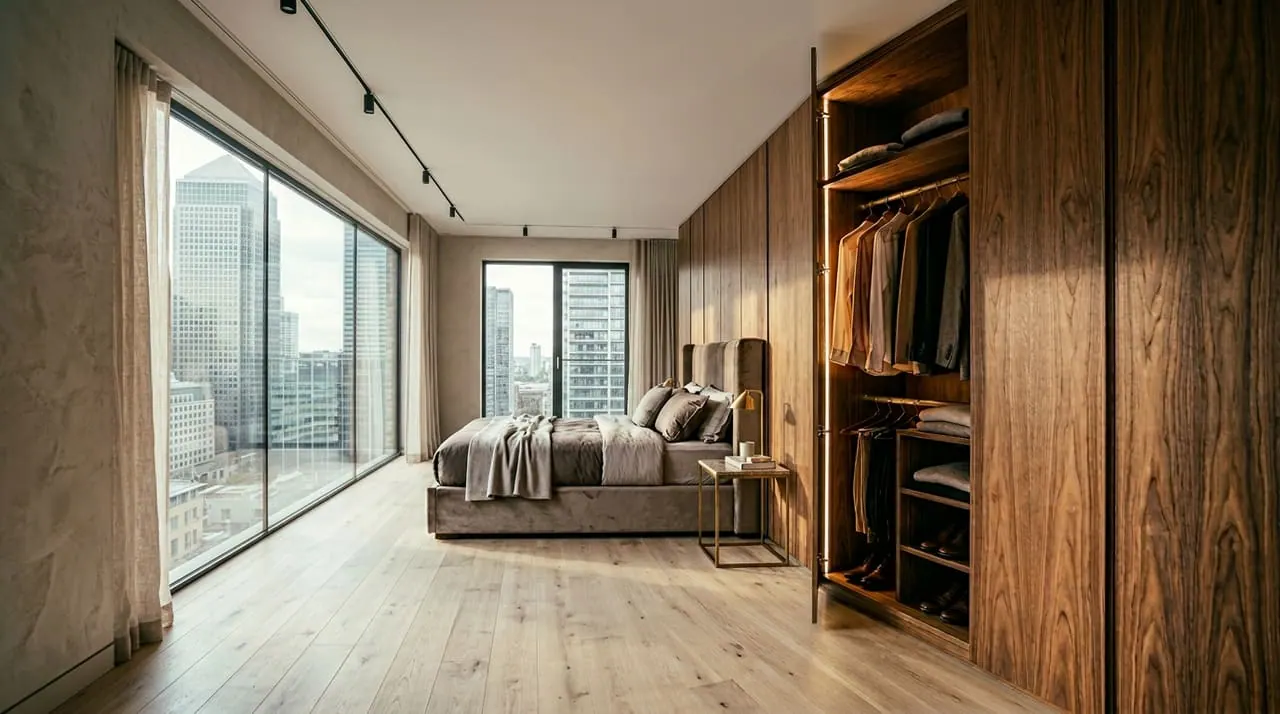
Fitted storage is the single biggest multiplier of a room's usable volume — and also the single easiest thing to get wrong. Here's the real difference between flat-pack, modular fitted, and proper bespoke joinery, in London 2026.
Flat-pack (IKEA Pax and similar)
What it is: modular chipboard carcasses that clip together, with a catalogue of door fronts and interior fittings.
Pros:
- Cheap: £400–£1,500 for a full wall
- Fast: two people can fit a full wall in a weekend
- Easy to reconfigure later
- The interior fittings (drawers, shoe racks, trays) are genuinely good
Cons:
- Standard heights stop at 236cm — on most London Victorian ceilings (270–320cm) you lose 40–80cm of usable storage above
- Standard depths (35cm or 58cm) are often slightly wrong for a given alcove
- Gaps at the edges where the carcass meets the walls — unless you cover with pelmet / scribe infills (fiddly DIY)
- The chipboard carcass sags over 10+ years under heavy clothes loads
When it's right: rental properties, short-term fit-outs, or a first-home stopgap. Also surprisingly good as a carcass system that a carpenter then trims out with bespoke cornice, plinth and scribe work to make it look built-in — best of both worlds.
Modular "fitted" (Hammonds, Sharps, Betta Living)
What it is: a semi-bespoke service — their surveyor measures, their factory builds melamine-faced chipboard cabinets to fit, their installer fits.
Pros:
- Fits floor-to-ceiling
- Standard configurations, reasonably short lead times (4–8 weeks)
- "Fitted" look — flush to walls, proper plinths, cornice
Cons:
- Still chipboard core. Not solid timber.
- The prices have drifted very high: £4,500–£12,000 for a wall
- Heavy sales tactics, "today only" pricing is routine
- Limited on paint finishes — catalogue colours only unless you pay bespoke rates
- Hardware (handles, hinges) is usually standard-issue, not upgradeable
When it's right: genuinely useful for run-of-the-mill bedrooms where you want a finished result without sourcing your own joiner. Always negotiate — the list price is never the real price. Aim for 30–40% off whatever they first quote.
Bespoke joinery
What it is: a local cabinetmaker measures in person, builds everything to your wall, in the exact wood or paint finish you choose, with proper hardware.
Pros:
- True fit — scribed to every wall bow and ceiling line
- Solid timber face frames, MDF doors with proper edge profiles, plywood or veneered-MDF carcasses (no chipboard)
- Any paint colour, any hardware, any internal configuration
- Lasts 25–40 years. Outlasts its room.
- Adds measurable value to London period properties
Cons:
- £6,500–£18,000 for a full wall, depending on complexity and finish
- Longer lead time (8–14 weeks from sign-off to install)
- Needs decent site conditions — can't install properly onto un-prepped walls
When it's right: long-term homes, period properties, anywhere aesthetic and permanence matter. Also the only real option for deep alcoves, angled walls, sloped ceilings in loft conversions, or any non-standard shape.
The honest decision
- Rental or stopgap: IKEA Pax with a carpenter trim-out
- Mid-market permanent home, boring shape: modular fitted (negotiated hard)
- Period property, alcove or sloped ceiling, long-term home: bespoke, every time
What to ask before you sign anything
- Carcass material? (Plywood beats chipboard beats MDF for wardrobes. Hardwood frames are the top end.)
- Hinge brand? (Blum is the standard. Anything else, ask why.)
- Drawer runner brand? (Blum Tandembox or Hettich Actro are the marks of quality. Avoid unbranded metal runners.)
- How is it fixed to the wall and floor? (Scribed, packed level, fixed into joists or properly into masonry — not just the plasterboard.)
- Paint finish — factory or on-site? (Factory-sprayed is more durable; on-site is more controllable. Both are valid; avoid hand-brushed on bespoke.)
- Guarantee period? (Bespoke should be 10+ years on the build. Modular fitted is usually 10 years. Flat-pack is essentially none.)
The trick most people miss
The handles and paint colour determine 70% of the perceived quality. A bespoke wardrobe with bad handles looks mediocre. An IKEA Pax painted properly and fitted with Armac Martin brass handles looks surprisingly high-end. If you're working a budget — cheap on the carcass, splurge on the ironmongery and the finish coat.
Need fitted joinery in a London home? Get in touch — we'll measure, quote, and fit properly, with timber and hardware that'll outlast the renovation around it.