Basement conversion cost in London, 2026
Full-dig vs tanking vs underpinning — what a London basement conversion costs in 2026, who you need on the team, and what actually goes wrong.
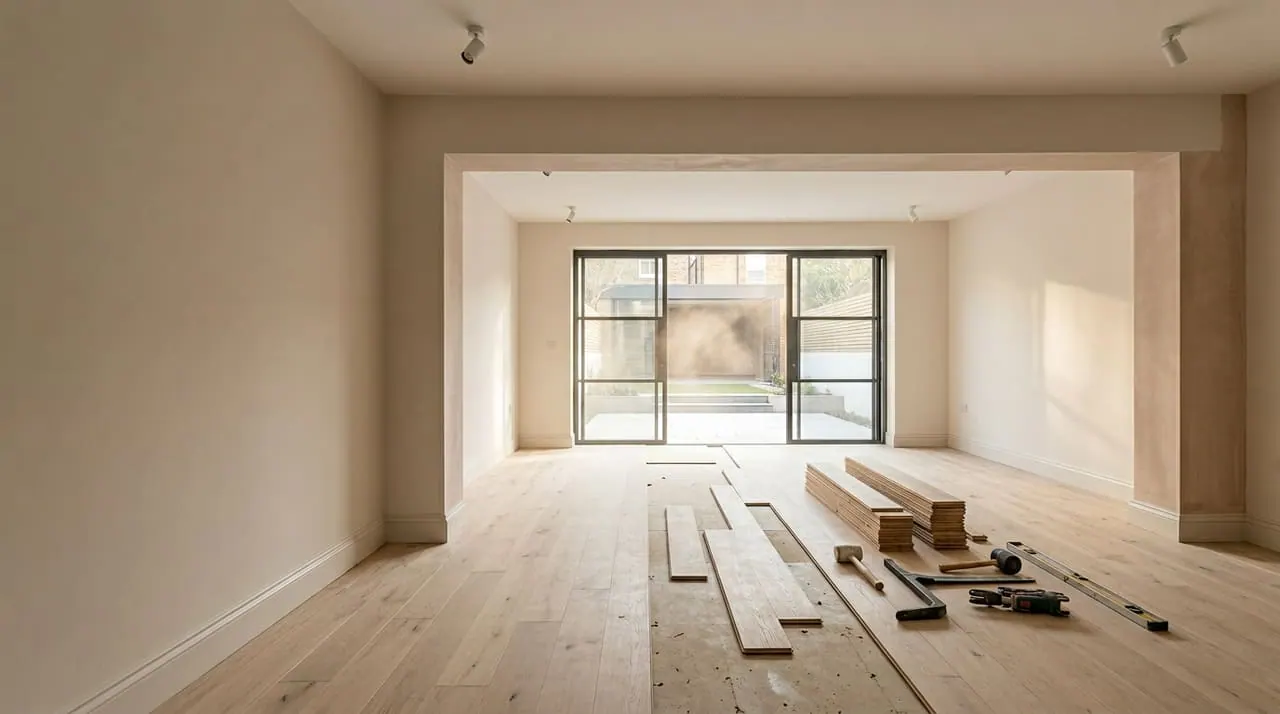
A basement conversion in London is the most complex residential project type there is. You are excavating below an occupied building, often within metres of adjacent occupied buildings, in a city built largely on London Clay. The cost reflects that complexity: £3,500–£5,500 per m² for a full new-dig basement, all-in. For a 50m² basement under a typical 3-bed London terrace, that's £175,000–£275,000 before you fit it out as a living space.
If those numbers make you pause, that's appropriate. But done properly, a basement conversion in a prime London postcode adds £80,000–£250,000 to sale value (Knight Frank 2025 research on prime London stock). On a Kensington or Notting Hill terrace worth £2m+, the economics work. In outer zone 4 suburbia, run the numbers carefully before committing.
Types of basement work — and why they're not interchangeable
"Basement conversion" is used to describe four fundamentally different project types with very different budgets and risks.
New full-dig basement
You excavate the ground beneath an existing building to create a new subterranean level that doesn't currently exist. This requires underpinning the existing foundations, temporary propping of the structure above, excavation and removal of significant volumes of material, construction of a new waterproofed reinforced-concrete box, and reinstatement of the ground floor above.
This is the most expensive and most complex type. It cannot be designed or built without a specialist structural engineer and a specialist basement contractor. Cost: £3,500–£5,500/m² including structure, waterproofing, and basic M&E fit-out. Excludes finishes, kitchen, bathrooms, and high-specification fit-out.
Lowering an existing basement slab
Many London Victorian and Edwardian properties have a semi-basement or lower ground floor with inadequate headroom (typically 1.8–2.0m, below the minimum 2.2–2.4m for habitable use). The solution is to lower the existing slab — either by breaking out and replacing it at a lower level, or by removing the sub-base entirely and constructing a new slab deeper.
This is cheaper than a full dig but still structurally complex, because lowering the slab changes the bearing conditions for the surrounding walls and may trigger underpinning requirements on the perimeter. Cost: £1,800–£2,800/m² for slab lowering by 600mm, including waterproofing and M&E. More complex if the slab is structural.
Converting an existing habitable basement
Some London period properties already have a functioning basement — often converted in the 1960s–1990s without proper waterproofing. Conversion here means upgrading the waterproofing, improving headroom where possible, replumbing, rewiring, and finishing to current standard. Cost: £800–£1,800/m² depending on extent and current condition. The waterproofing element is usually the most important decision (see below).
Lightwell addition
Creating or enlarging a front or rear lightwell to bring natural light and ventilation to an existing lower ground floor. Often done alongside a basement conversion but also as a standalone project. Involves groundworks and retaining walls, and may require planning permission depending on the front/street relationship. Cost: £15,000–£35,000 for a standard London terrace front lightwell (excavation, reinforced concrete retaining walls, drainage, metalwork grille). Side or rear lightwells at similar scale.
Full-dig basement cost: central vs outer London
Location affects cost even within London.
Prime central London (Kensington, Chelsea, Westminster, Camden, Mayfair): £4,500–£5,500/m². Higher costs driven by logistics (constrained sites, no room for spoil, material delivery in narrow streets), planning complexity (see the Basements Impact Assessment requirement below), and the calibre of contractor and consultant typically required on these projects. Knight Frank data: prime central London basement adds £80,000–£250,000 to value.
Inner London (Islington, Hackney, Lambeth, Southwark, Wandsworth): £3,500–£4,800/m². Similar structural challenges but more accessible sites and slightly less planning friction.
Outer London: £3,000–£4,200/m². More workable access, lower logistics costs, but the same structural engineering requirements.
These are construction costs only. Add professional fees (structural engineer, architect, planning consultant, party wall surveyor, BCO) of £15,000–£40,000 depending on project complexity.
Underpinning: what it is, when it's needed, and who does it
Underpinning is the process of extending the existing foundations downward to allow excavation below them. On a full-dig basement, every section of the perimeter wall needs underpinning in sequence — one bay at a time, with temporary propping at each stage, until the full perimeter has been taken to the new founding level.
The most common method in London is mass concrete underpinning (traditional pit method): excavating bays of approximately 1m width to the new founding depth, pouring mass concrete, curing, moving to the next bay. This is methodical and proven, but slow — typically 6–10 weeks for underpinning alone on a standard terrace.
Alternative methods — mini-piling with ground beams, jet grouting — are used where ground conditions (particularly running sands or high water tables, both found in certain London zones) make traditional underpinning impractical. These are more expensive by 30–50% but sometimes unavoidable.
Underpinning to a depth of 2.5m on a standard terrace typically costs £30,000–£65,000 as a sub-contracted element, before any excavation, waterproofing, or structure above it.
Waterproofing grades — Type A, B, and C
Waterproofing a below-ground structure is not a single product decision. BS 8102 (Code of Practice for Protection of Below Ground Structures Against Water Ingress) defines three approaches, and for Grade 3 usage (habitable spaces: bedrooms, living rooms, kitchens) a multi-system approach combining types is standard practice.
Type A — Barrier (tanking). A waterproof barrier applied to the outside (or inside) of the structure. Products include crystalline coatings (Xypex), cementitious systems (Sika, Remmers), and bonded sheet membranes. Effective if the application surface is properly prepared and the concrete is sound. Vulnerable to any future structural movement. Not recommended as the sole waterproofing system for Grade 3 habitable use in London's clay soil conditions.
Type B — Integral structural waterproofing. Waterproofing is designed into the concrete structure itself via admixtures (Sika WT-100, Mapei Tricosal) or hydrophilic waterstops at construction joints. Effective and durable, but only as good as the concrete pour and formwork quality.
Type C — Drained cavity drainage. A cavity drainage membrane (Newton 508, Wykamol CDM, Delta MS-500) is installed against the inside face of the wall and floor, directing any water ingress to a sump chamber and pump system. This is the dominant system in London basement conversions because it manages water rather than stopping it — acknowledging that London Clay creates hydrostatic pressure that static barrier systems eventually lose to.
For a new-dig basement in London intended for habitable use, the standard specification is Type B + Type C: waterproof concrete structure with integral admixtures, plus an inner cavity drainage membrane vented to a sump. This is what the NHBC and most warranty providers require for a 10-year guarantee. The named products above — Newton, Wykamol, Delta MS-500 — all have contractor accreditation schemes. Insist on an accredited installer.
Type A tanking alone is appropriate for storage vaults and lower-grade usage. It's cheaper (£80–£150/m² vs £180–£300/m² for a Type C cavity system installed), and unscrupulous contractors will quote it for habitable spaces to appear cheaper. It is not adequate for a habitable basement in London. This is the single biggest specification failure on London basement projects.
Party wall implications for basement excavations
The Party Wall etc. Act 1996 Section 6 applies when you excavate within 3 metres of an adjoining owner's structure to a depth greater than that structure's foundations. In practice, this means almost every full-dig London basement triggers Section 6 notices.
The process:
- Serve a notice on all adjoining owners (attached neighbours and, in some cases, across-the-road owners if the excavation is deep enough).
- Neighbours have 14 days to consent or dissent.
- If they dissent (very common on basement projects), a Party Wall Award is required — a legal document agreed between your appointed surveyor and their appointed surveyor setting out the work, monitoring requirements, and condition schedules.
Party wall surveyor cost for a basement project: £1,500–£3,500 per adjoining owner. On a mid-terrace with two adjoining owners, budget £3,000–£7,000 in surveyor fees — which comes out of your pocket even if the neighbours don't contribute a penny themselves.
In addition, most London borough Party Wall Surveyors now require pre- and post-construction monitoring of neighbouring buildings: crack monitors, settlement gauges, and survey photography before works begin and at regular intervals during excavation. This adds £3,000–£8,000 per monitoring programme.
Planning permission for basement digs
Not all London basement conversions require planning permission. But the planning landscape has tightened significantly since 2015.
Westminster, RBKC (Kensington and Chelsea), and Camden all require a Basements Impact Assessment as part of any planning application for a new excavated basement. This is a specialist report covering hydrological impact, structural impact on adjacent properties, and construction management. A BIA costs £3,000–£8,000 and adds 4–8 weeks to the pre-application phase.
Most other London boroughs have adopted SPD (Supplementary Planning Document) guidance on basement development since 2018, restricting basements to one storey, prohibiting them under the majority of garden area, and requiring detailed construction method statements. These don't necessarily require a BIA but do require an architect and planning consultant to manage the application.
Permitted development technically applies to basement works that don't affect the external appearance of the property and don't constitute a change of use. However, virtually every full-dig basement involves sufficient external works (lightwells, plant enclosures, access stairs) to require at least a Lawful Development Certificate application. Don't assume PD applies — confirm it with a planning consultant before starting design.
Planning application fee for a householder application (England): £258 from April 2025. But for a basement dig in a restricted borough, the planning consultant fees and BIA costs alone are £8,000–£20,000. Budget accordingly.
The professional team for a basement project
A full-dig London basement is not a project you can manage with just a builder. The minimum required team is:
- Architect: Design and planning application. £5,000–£15,000 for a basement-only instruction.
- Structural engineer (MIStructE or CEng level): Underpinning design, temporary works design, permanent structure, waterproofing specification. £5,000–£15,000. A basement dig structural package alone (without full renovation) is £5,000–£15,000.
- Waterproofing specialist: Should be independent of the contractor — either a manufacturer-accredited consultant or a specialist designer. Newton, Wykamol, and Sika all have approved contractor networks with design support.
- Party wall surveyor: Required on virtually all London basement projects. £1,500–£3,500 per owner affected.
- Planning consultant: Advisable for Westminster, RBKC, Camden, and conservation area properties. £3,000–£8,000.
- Building Control Officer (BCO): Either through the local authority or an Approved Inspector. Budget £1,500–£3,500 in inspection fees for a basement project.
Total professional fees on a full-dig London basement: £20,000–£50,000 on a mid-size project. These are not optional extras. They are the framework that makes the project legal, insurable, and safe.
Realistic timelines and what affects them
Design and approvals phase: 3–8 months depending on borough. Westminster and RBKC planning can take 6 months for a basement application due to the BIA requirements and consultation periods.
Underpinning and excavation: 6–12 weeks for a typical London terrace basement.
Reinforced concrete structure and waterproofing: 4–8 weeks after excavation.
M&E first fix and internal structure: 4–6 weeks.
Second fix and fit-out: 4–10 weeks depending on specification.
Total on-site: 5–8 months for a full-dig basement from strip-out to completion. Total project from first design appointment to BCO sign-off: 10–18 months for a straightforward project; 18–24 months or more in restricted boroughs.
What delays basement projects
Groundwater. London sits on complex geology: London Clay over Thanet Sand over Chalk. In areas near the Thames or former water courses (large parts of west and south London), groundwater levels can make excavation significantly more complex. Groundwater management (dewatering) may be required — adding weeks and cost.
Adjoining owner disputes. A neighbour who appoints a combative party wall surveyor and demands unreasonable monitoring conditions can add 2–6 months to the project timeline while surveyors negotiate.
Unforeseen ground conditions. Old drainage runs, Victorian wells, buried timbers, and contaminated land have all been found during London basement excavations. A pre-contract trial pit investigation (£800–£1,500) is worth doing before you appoint a contractor.
Concrete cure times. A properly specified basement concrete (C35/45 with waterproofing admixture) requires 28 days minimum cure before post-tensioning or loading. Rushing this creates the waterproofing failures that show up 3–5 years later.
Hidden costs nobody quotes for
1. Pre-works condition survey on neighbouring properties. Essential before excavation starts, and sometimes a contractual requirement from the party wall award. £500–£1,500 per property. Skipping this leaves you exposed to any spurious damage claims after completion.
2. Sump and pump maintenance. A Type C drainage system has a sump chamber with submersible pump that has to work every day for the life of the building. The pump needs servicing annually (£150–£300/year) and replacing every 7–12 years (£600–£1,500). Budget for this from day one.
3. Radon assessment. Parts of London (particularly north and east) are in radon-affected areas. If Building Control flags this, a radon barrier and ventilation system is required — add £2,000–£5,000.
4. Temporary propping and monitoring costs during construction. Acrow prop hire and engineer-specified temporary works monitoring: £3,000–£8,000 over the excavation period.
5. Spoil removal. Excavating a 50m² basement to 3m depth generates approximately 150 tonnes of spoil. In London, removing this from a constrained site requires multiple skip loads or a conveyor belt system off the front of the property. Budget £3,000–£7,000 for spoil removal, including skip licences and lorry permits.
6. Insurance uplift during works. Your buildings insurance needs to be notified of major structural works. Many policies have exclusions for below-ground structural work. You may need contract works insurance via your contractor — confirm this before works start. Contract works insurance for a £250,000 basement project: £1,500–£3,000 for the duration.
7. M&E commissioning and certification. A basement habitable space requires full electrical installation certificate (NICEIC or NAPIT), potentially a Gas Safe certificate if there's a boiler or gas appliance in the space, and a waterproofing guarantee (typically 10–25 years from a Newton, Wykamol, or Delta-PT accredited installer). Certificates are required for building control sign-off.
Who TB&D is right for on a basement project
A full-dig new excavation under an existing London terrace is a project for a specialist basement contractor — typically a company that does nothing else, with their own underpinning crews and waterproofing accreditations. TB&D builds in the renovation and extension space and manages whole-house projects that include a basement element, but we're direct about our scope: full-dig new basements require a specialist underpinning contractor as the principal subcontractor.
Where TB&D adds real value on basement projects: managing the full project around the basement dig — the above-ground renovation, the fit-out, the kitchen and bathrooms, the M&E throughout the whole property, and coordinating the specialist basement contractor alongside all other trades. We're also the right call for converting an existing semi-basement with proper waterproofing, lowering a slab, or adding a lightwell. The party wall guide on this site covers the Section 6 notice process in detail — worth reading before you approach any neighbouring owners.
We carry £1m public liability insurance and £5m employers' liability insurance and provide a single project manager for the entire job. Every basement project quote is itemised to trade level so you know exactly what your principal contractor is charging versus what's being subcontracted.
Contact TB&D for an initial assessment of whether your property is a viable basement candidate before committing to architect or engineer fees. A 30-minute site visit from an experienced London builder will tell you more than three hours of desktop research. Alternatively, use the three-minute online estimator to get a cost range before booking anything.
Considering a basement as part of a whole-house renovation? The full house renovation cost guide covers how the basement element integrates with the overall project budget and programme.