House extension cost in London, 2026
What a London house extension actually costs in 2026 — rear, side return, two-storey and wrap-around — with real m² rates, hidden costs, and timeline.
A house extension in London in 2026 costs between £2,000 and £3,800 per m², depending on storey count, specification, and how much structural complexity your plot creates. For a typical 25m² rear extension, that's a range of £50,000 to £95,000 before you furnish it. Vague? Yes. But "house extension" is an umbrella term that spans a lean-to conservatory and a two-storey steel-frame rear addition, so the range is honest. Here's how to narrow it down.
What drives extension costs in London
Size is obvious. The less obvious drivers are:
Storey count. A single-storey rear extension is simpler to scaffold and weather-proof. Two-storey means structural walls carrying a new floor load, more steels, more complex party wall implications, and often planning permission rather than permitted development. Plan for 20–30% more per m² on the second storey.
Structural complexity. An extension that removes the entire rear wall of a Victorian terrace (often the most popular configuration) requires steel beams across the full width plus columns or padstones into the party wall. That's a structural engineering package (£1,500–£3,500 for calcs and drawings) and significantly more groundworks than a simple bolt-on.
Roof type. Flat-roof extensions are cheaper to build (by around £150–£300/m² in structure) but carry ongoing maintenance if a budget EPDM membrane is used instead of a quality liquid-applied system (Kemperol, Sika Trocal). A pitched or mono-pitch roof costs more upfront but is nearly maintenance-free.
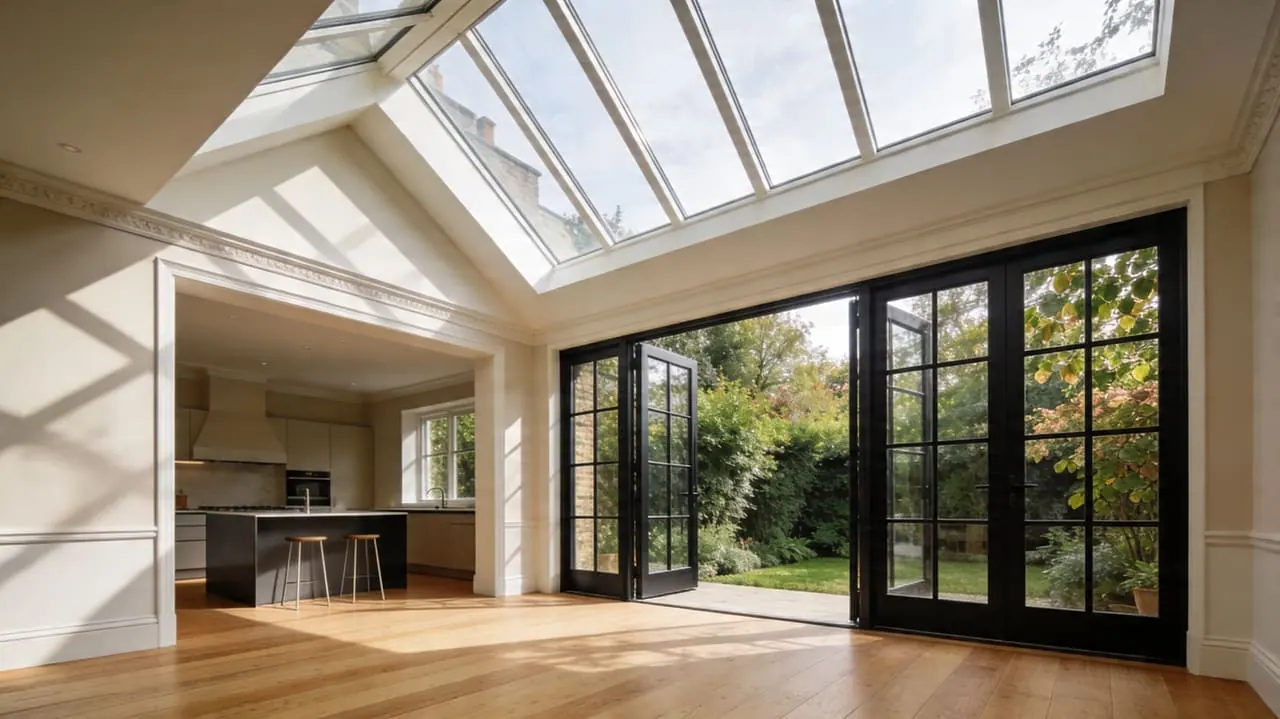
Glazing specification. Full-width bifold or sliding doors (Schüco, IDSystems, Origin, Crittall-style steel) can add £10,000–£25,000 to the glazing line alone. Rooflights — Velux, Fakro, or bespoke lanterns — add £800–£9,000 per unit depending on size and frame type.
Ground conditions. Victorian London terraces often have shallow strip foundations at 600–900mm. A new extension pad foundation typically needs to go to 1.2–1.5m minimum, and on clay soils (much of south and north London) you're dealing with heave risk that may require raft foundations or vibro-compacted aggregate pads.
Cost per m² by extension type
All figures are for London in 2026, materials and labour included. Excludes professional fees, party wall costs, and client-supplied fixtures.
Single-storey rear extension — £2,000–£3,200/m² The bread-and-butter London extension. A 20–30m² single-storey kitchen-diner addition in a mid-spec finish (Howdens or comparable kitchen, standard tiles, composite roof, bifolds) lands at £50,000–£80,000 completed. Premium finishes (bespoke kitchen, Crittall-style doors, natural stone floor) push the per-m² rate towards the upper end.
Side-return infill — £2,200–£3,400/m² The classic Victorian terrace side return. A narrow strip (usually 1.8–3m wide, running from the back of the main house to the bottom of the plot) is infilled to create a wider ground-floor plan. Trickier to build than it looks — the original side wall of the back addition is demolished, an RSJ carries the party-wall load, and working in a confined access corridor pushes labour time up. Typical completed project: £55,000–£110,000 for 20–35m².
Two-storey rear extension — £2,400–£3,800/m² Higher per-m² rate than single-storey, but total cost per room is better value once the structural and roof costs are amortised across two floors. Requires full planning permission in most London boroughs (PD limits don't extend to two-storey rear). Add £3,500–£8,000 for planning fees and architect drawings.
Wrap-around (rear + side return combined) — £2,300–£3,500/m² The most transformative ground-floor configuration. A rear extension plus side-return infill in a single build. Complex to sequence (often two RSJ beams, one on the rear wall and one on the flank) but very efficient per m² because overheads and groundworks costs are shared. A full wrap-around on a typical 3-bed Victorian terrace runs £90,000–£160,000.
Over-garage extension — £1,800–£2,800/m² Lower per-m² rate because the garage slab and walls do much of the structural work. Check the garage structure — many 1970s garages have insufficient loadbearing walls and the existing slab needs breaking out and replacing. Party wall issues apply if the garage is on the boundary.
What's actually included in a proper extension quote
A legitimate London extension quote should itemise: surveys and structural engineer fees, demolition and groundworks, underpinning or foundation work (if applicable), concrete slab or beam-and-block floor, external walls (brick, blockwork, insulation), structural steelwork, roof structure and weatherproofing, external doors and glazing, internal finishes (first-fix plumbing and electrics, insulation, plastering), decoration, and a BCO inspection allowance.
If a quote is a single lump sum with no breakdown, that's not a quote — it's an opening bid. Ask for it itemised. Any major item can be priced against alternatives and any surprise mid-project is much easier to handle when there's a baseline breakdown to refer to.
What's typically excluded
Most extension quotes exclude: kitchen units and appliances (priced separately), floor finishes (supply and fit), bathroom sanitaryware and tiling (if the extension includes a WC or bathroom), soft furnishings, and external landscaping beyond the immediate build footprint. Always clarify the boundary.
Hidden costs nobody quotes for
1. Party wall surveyor fees. If your extension is within 3m of the boundary and deeper than your neighbour's foundations, or involves cutting into a shared wall, the Party Wall Act applies. Your neighbour is entitled to appoint their own surveyor — at your cost. Budget £700–£1,500 per adjoining owner in 2026. Semi-detached and terrace owners routinely face costs on both sides. Don't budget zero.
2. Building control fees. A Regularisation or Building Regulations application for an extension costs £1,200–£2,800 depending on borough and notional project value. This is separate from planning application fees. Some boroughs charge at the lower end; Kensington & Chelsea and Westminster tend towards the upper end.
3. Temporary kitchen/bathroom provision. If your rear extension takes out the only downstairs bathroom or makes the kitchen unusable for 8–14 weeks, you need a plan. A temporary kitchen (camping-style setup) is free; a temporary bathroom pod rental is £400–£800 per month. Most homeowners underestimate how disruptive this is.
4. Party wall structural survey. Before demolition of a party or shared wall, a structural survey of the adjoining property is often required to establish pre-works condition. This protects both you and your neighbour from disputed damage claims. £500–£1,200.
5. Asbestos survey. Any pre-2000 property being significantly altered needs a refurbishment asbestos survey (not a management survey). The difference is important — a refurbishment survey destructively investigates inside materials that will be disturbed. £250–£600. If asbestos is found, licensed removal is £800–£4,000+ depending on extent.
6. Skip hire and parking suspensions. Skips on a London street require a council licence (£40–£100 per week). If there's no room for a skip, bagged waste collection is 30–40% more expensive. Construction parking suspensions on permit-controlled streets: £40–£80 per week. Petty costs that add up to £2,000–£5,000 on a 16-week project.
7. M&E design and upgrade. If the extension creates a new kitchen-diner with an island, extractor, underfloor heating, and bi-directional lights, your existing consumer unit may need upgrading. A full consumer unit replacement is £1,200–£2,500. New circuits add £200–£600 each.
8. London clay ground movement. South and north London sit on London Clay, which expands and contracts significantly with seasonal moisture. If you're building adjacent to trees (which is virtually guaranteed in suburban London), a specialist engineer may require deeper foundations or a cellular raft to manage differential settlement. This can add £5,000–£20,000 to groundworks in edge cases.
How long does a house extension take?
Design and planning phase: 4–12 weeks. Structural engineer, architect drawings, planning application (8 weeks determination target for householder applications), party wall notices (minimum 2 months if neighbours dissent).
Pre-construction (after approvals): 2–4 weeks. Final contractor pricing, material orders, site setup.
On-site timeline by type:
- Single-storey rear extension (standard): 10–14 weeks
- Side-return infill: 12–16 weeks
- Two-storey rear extension: 16–22 weeks
- Wrap-around: 16–24 weeks
Total from initial design to move-back-in: 14–24 weeks for most single-storey projects once planning is approved. Add the planning phase and you're looking at 6–9 months from initial brief to completed extension.
The biggest delay on most London extension projects isn't the build — it's steel beam fabrication lead times (Kloeckner, Rainham Steel: 3–5 weeks for bespoke fabrication) and building control inspection availability during busy periods. A well-programmed contractor orders structural steels the moment planning is granted, not when they're needed on site.
Planning permission: what you need to know before you start
Most single-storey rear extensions on houses (not flats) fall under Permitted Development (PD) rights, which means no formal planning application is required — but the rules are precise.
Under PD, a single-storey rear extension on a terraced house can project up to 6 metres from the original rear wall (4m without prior approval; up to 6m with a Prior Approval application to the council). Detached houses get up to 8m. The extension must not exceed 4m in height, must not cover more than 50% of the original garden, and must use materials similar in appearance to the existing house.
PD rights are removed or restricted in:
- Conservation areas (many inner London neighbourhoods)
- Article 4 Direction areas (which individual boroughs apply — over 60 London boroughs have some Article 4 zones, some covering the entire borough like Westminster)
- Listed buildings (always need Listed Building Consent)
- Flats and maisonettes (PD doesn't apply at all)
A Prior Approval application (simpler and faster than full planning) is required for extensions between 4m and 6m on terraced houses, or 4m and 8m on detached. The determination period is 42 days.
Full planning permission is required for: two-storey extensions (always), side extensions on terraced houses, any extension in a conservation area that would be visible from a highway, or where PD has been removed. Budget £258 for the householder planning fee (England, from April 2025) plus architect fees of £2,000–£5,000 for drawings and planning management.
Don't assume PD applies to your property without checking. A call to the planning department, a Lawful Development Certificate application (£103 fee), or an hour with a planning consultant (typically £300–£600 for written advice) is money well spent before you start spending on architect drawings.
Is a house extension worth it in 2026?
In prime and inner London, yes — almost always. Nationwide and Savills data puts the average London property value uplift at £400–£700 per m² of added floorspace. A 25m² extension costing £70,000 should add £100,000–£175,000 to a property in zones 1–3. Beyond zone 4, the numbers are less reliable — check your postcode against local comparables before committing.
The break-even calculation is even stronger when you factor in the cost of moving: stamp duty, agent fees, and legal costs on a London home sale/purchase in 2026 easily run £30,000–£80,000. An extension that gives you the space you need without moving is almost always the better financial decision.
A well-executed rear extension or wrap-around also unlocks a complete reconfiguration of the ground floor — the kitchen moves into the extension, the old kitchen becomes a utility or study, and the through-room suddenly makes sense spatially. That reconfiguration effect is what drives the value uplift beyond just the additional m².
One caveat: the extension has to be competently designed and built. A poorly executed extension with a leaking flat roof, cracking where the new build meets the old, or a badly specified kitchen diner will add nothing — and potentially detract. The £20,000-cheaper quote is rarely the better outcome at completion.
How to get accurate quotes
Before calling a builder, have the following ready: OS or site plan showing plot boundaries, a rough brief of what you want (m² target, number of rooms, finishes level), confirmation of whether you're in a conservation area or Article 4 area, and if you've already spoken to a planning officer, their written feedback.
A proper house extension quote should be based on a site visit, not a phone call. Any builder who gives you a fixed price without seeing the site, checking the ground floor layout, and understanding the party wall situation is guessing. The quotes that come back £20,000 cheaper than everyone else are almost always missing something — usually the groundworks or the structural steelwork.
TB&D carries £1m public liability insurance and £5m employers' liability insurance and provides itemised quotes within 48 hours of a site visit. Our Checkatrade rating of 9.92 across 247+ jobs reflects a consistent approach to fixed-price contracts and no end-of-project surprises. Get a quote or read how we approach extensions before you decide.
Comparing extension types or unsure about planning? The kitchen extension planning permission guide covers permitted development rules in detail.