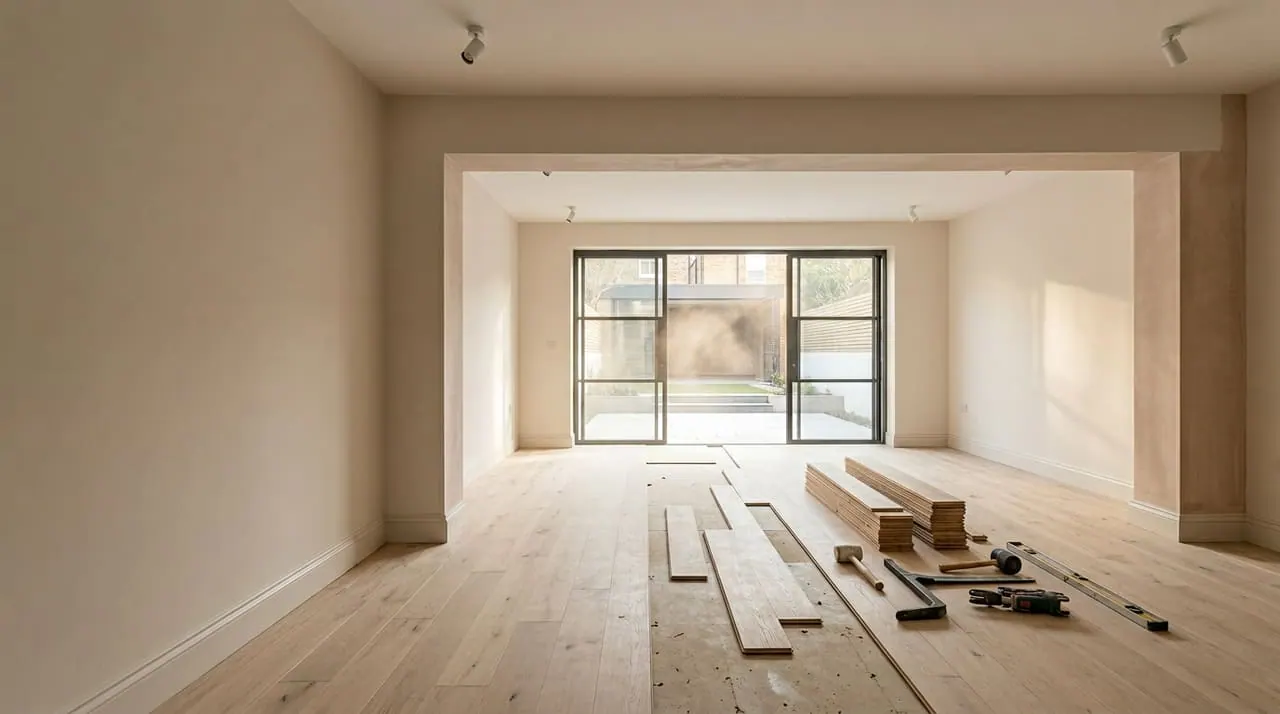
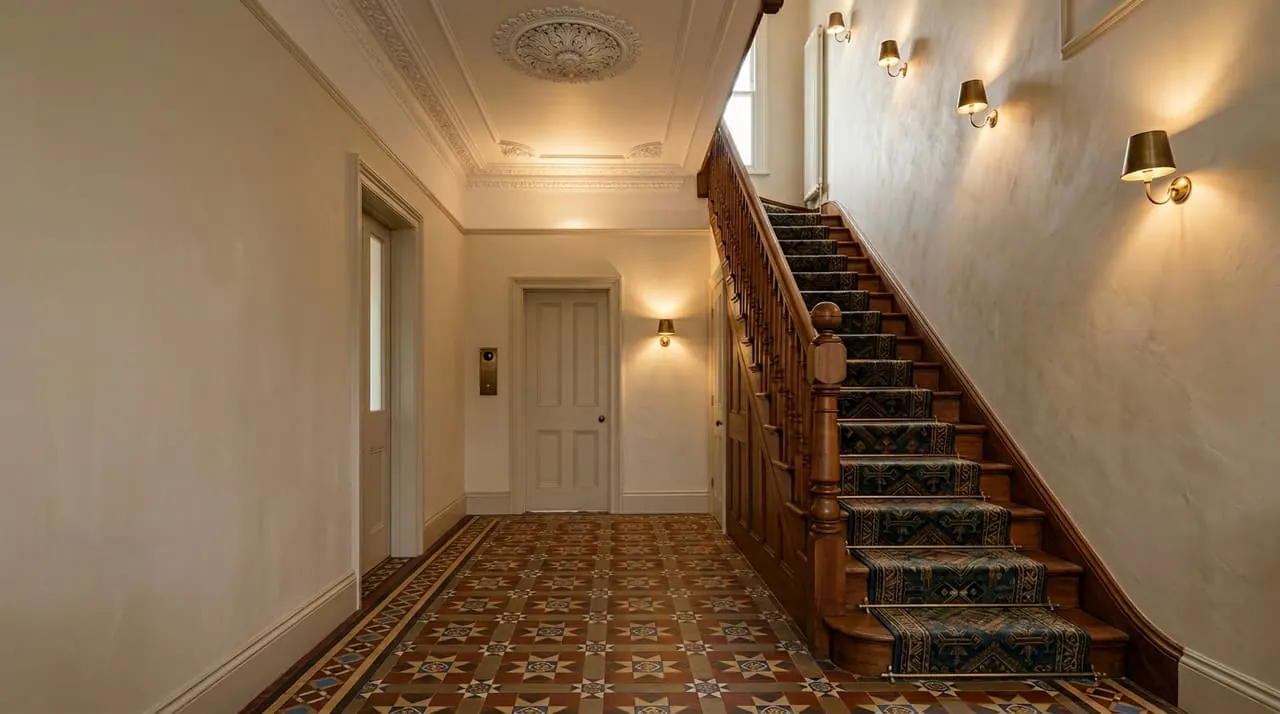
Full house renovation cost in London, 2026
Room-by-room cost breakdown for a whole-house renovation in London in 2026 — from a 1-bed flat to a 5-bed detached, with realistic contingency and timeline.
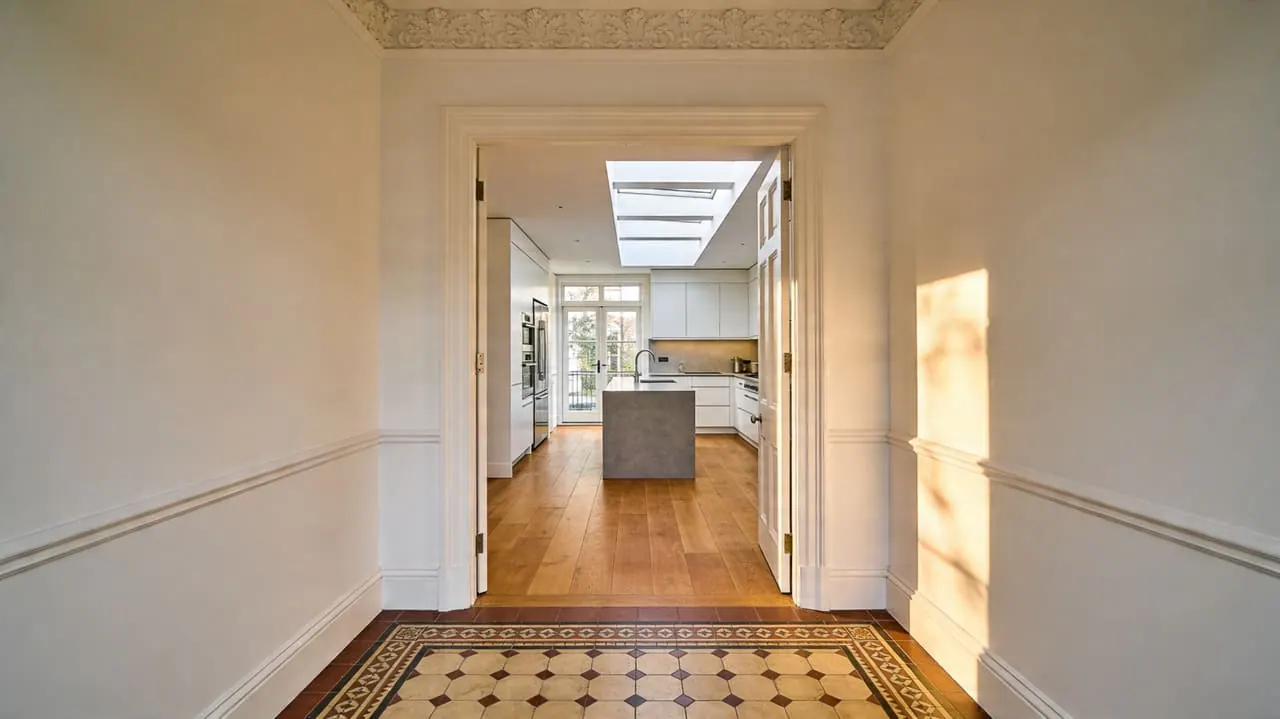
A full house renovation in London in 2026 costs £800–£1,800 per m², depending on the scope, specification, and condition of the existing property. That's a total cost of:
- 1-bed flat (45–55m²): £35,000–£90,000
- 2-bed flat (65–80m²): £55,000–£130,000
- 3-bed terrace (85–115m²): £90,000–£220,000
- 4-bed Victorian semi (130–160m²): £130,000–£300,000
- 5-bed detached (200–300m²+): £250,000–£600,000
The spread within each bracket is driven by three things: how much structural work the property needs, what M&E (mechanical and electrical) infrastructure exists and how much of it needs replacing, and what finish level you're targeting. Here's how to work out where your project sits.
What counts as a "full renovation"?
There's no agreed industry definition, which is why quotes vary so wildly. For this guide, "full renovation" means: all rooms stripped back to a habitable-but-unfinished state; new or upgraded M&E throughout; structural alterations as required; and a full finishes package (tiling, flooring, decoration, kitchens, bathrooms) to completion.
It does not include extensions or loft conversions (those are priced separately). If you're adding an extension alongside a full renovation, see the house extension cost guide for that element and budget the two separately.
A "light renovation" — new kitchen, new bathroom, redecoration — is a different category. Budget £30,000–£80,000 for a 3-bed terrace at that scope. The figures in this guide are for the whole stack.
The renovation stack: what each layer costs
A whole-house renovation has distinct cost layers. Understanding them separately stops you under-budgeting the invisible ones.
Layer 1: Structural works
Structural works are the most variable cost in the whole project. A 1960s semi with a reasonable structural condition costs almost nothing here. A Victorian terrace that needs a loft beam, RSJ across the rear of the ground floor, and chimney breast removal on two floors can easily run £25,000–£60,000 in structural cost alone before you've touched finishes.
Common structural items in a London whole-house project:
- Chimney breast removal (ground + first floor, with support flange/padstone): £3,500–£7,000 per floor removed
- Rear party-wall opening, RSJ (standard 4.8m span): £3,500–£8,000 including structural engineer
- Spine wall removal (where it divides the through-room): £4,000–£10,000 including steels, calcs, and BCO inspections
- Structural floor replacement (e.g. rotten joists throughout): £4,000–£9,000 for a 3-bed terrace
- Underpinning (subsidence, or extending footprint): £8,000–£25,000+ depending on scope
For any load-bearing alteration, Building Regulations Part A requires structural calculations by a chartered structural engineer (MIStructE or CEng). This isn't optional and isn't something a builder should be glossing over. Engineer fees for a standard wall removal are £400–£900 for calculations and drawings alone.
Layer 2: Services — M&E
The M&E layer is where the biggest surprises hide. Rewiring and replumbing a property that's never been properly done is absolutely necessary but completely invisible in the finished result — which is why clients sometimes try to skip it or do it half-heartedly.
Full rewire (3-bed terrace): £5,500–£9,000. Includes consumer unit replacement, new cabling throughout, new sockets, switches, and lighting points. Does not include the light fittings, smart controls, or underfloor heating mats — those are specified separately.
Full replumb (3-bed terrace): £7,000–£14,000. New mains supply connection (if needed), new hot and cold distribution, waste runs, soil stack work where the layout is changing. Add £2,500–£5,500 if you're switching from a gravity-fed cylinder system to a combi boiler or unvented cylinder.
Boiler replacement: £2,000–£3,500 for a like-for-like combi swap. More if the flue route changes or if the system needs upgrading to accommodate a new heating zone layout. All gas work must be carried out by a Gas Safe registered engineer — not just "someone who knows about boilers."
Underfloor heating (wet, screed-embedded): £80–£130/m² supply and install including screed. Plan for minimum 75mm screed depth, which means losing 75–90mm of floor height across the whole ground floor — a significant consideration in period properties.
Mechanical ventilation: Building Regulations Part F requires controlled ventilation in all habitable rooms where significant envelope works are done. On a whole-house project, you're almost certainly required to upgrade extraction in bathrooms and kitchens. An MVHR (Mechanical Ventilation with Heat Recovery) system for a 3-bed is £4,000–£9,000 installed, but most mid-spec London renovations use individual room extractors (£150–£400 per room fitted).
A full M&E package for a 3-bed terrace renovation — rewire, replumb, boiler, extraction — runs £18,000–£32,000 before any heating controls, smart systems, or UFH.
Layer 3: Fabric works
Fabric works cover everything from the inside of the walls to the subfloor: insulation, boarding, plasterwork, screeds, floor preparation.
Plastering (full replaster, 3-bed terrace): £6,000–£12,000 for a skim coat over plasterboard throughout. Add £3,000–£6,000 if you're replacing all the lath-and-plaster throughout a Victorian property.
Floor preparation and screed: £3,000–£7,000 for a typical terrace, more if you're installing UFH or levelling a badly uneven substrate.
Insulation upgrades (Part L compliance): Whole-house projects now trigger Part L of the Building Regulations, requiring demonstrable improvement in thermal performance. For a Victorian solid-wall terrace, this typically means insulated plasterboard (40mm Kingspan or Knauf on external walls) in all external-wall rooms — add £4,000–£9,000 and lose 45–55mm of room depth on every external wall.
Layer 4: Finishes
Finishes are where the cost range is widest and where client choice makes the most difference.
Kitchen: A Howdens or Magnet kitchen in a standard layout runs £8,000–£18,000 supply and fit including worktops. A mid-spec semi-bespoke kitchen (Tom Howley, Neptune, Naked Kitchens) is £20,000–£45,000. A fully bespoke kitchen (Plain English, deVOL, John Lewis of Hungerford) starts at £40,000 and frequently exceeds £80,000 with appliances.
Bathrooms: For full renovation costing, use £10,000–£18,000 for a mid-spec bathroom and £6,000–£10,000 for an en-suite as a per-room allowance. See the bathroom renovation cost guide for the detailed tier breakdown.
Flooring (throughout): Engineered oak or good-quality LVT throughout a 3-bed: £6,000–£16,000 supply and fit. Stone or large-format porcelain on ground floor: add £3,000–£8,000.
Decoration (full repaint, 3-bed): £3,500–£7,000 for proper preparation and two coats throughout, all ceilings and woodwork.
Joinery: Skirting, architraves, door linings, internal doors — budget £3,000–£8,000 supply and fit for a 3-bed in mid-spec. Bespoke or heritage-matched joinery is significantly more.
Kitchen and bathroom allowances within a full renovation
One question every homeowner on a whole-house project struggles with: how do I budget for kitchens and bathrooms separately from the main renovation?
The M&E and fabric layers above cover the underlying work — the plumbing first fix, the wiring, the waterproofing and substrate prep. The finish-out cost — units, sanitaryware, tiles, and second-fix fittings — is the design budget and should be treated separately.
Rule of thumb for a 3-bed London renovation:
- Kitchen finish-out: £12,000–£50,000 (specify your tier early)
- Master en-suite: £10,000–£22,000
- Family bathroom: £10,000–£20,000
- Guest WC or cloakroom: £4,000–£8,000
These are not separate jobs for a different contractor — they're phases within the same project programme. Trying to hand off the kitchen installation to a different team while your main contractor is still on site is the single most common source of delays and disputes on whole-house projects.
Structural work: removing walls, RSJs, and new openings
Most 3- and 4-bed London terrace renovations involve at least one structural alteration. The rear wall opening for a kitchen-diner and the removal of a chimney breast are the two most common.
Rear wall full-width opening (typical Victorian terrace, 4.8m RSJ): £3,500–£8,000. This includes structural engineer calculations, the steel beam, padstones, temporary acrow propping, and BCO inspections. It does not include the bifold/sliding doors, which are separate.
Chimney breast removal (one floor): £3,500–£7,000. Two floors out: £6,000–£12,000. Stack retained at roof line (most common for planning/structural reasons): no saving — the removal from habitable rooms is the expensive part.
Partition wall removal (non-structural): £800–£2,500 including making good, replastering, and floor patching.
Any of these trigger Building Regulations Part A. A BCO (Building Control Officer) inspection is required before concealing the steelwork. Do not board over a beam without a BCO visit — you'll need to open it up again before a house sale if you do.
M&E: when to do the full rewire and replumb
The uncomfortable truth: if you're doing a full renovation and the property has the original 1970s or earlier wiring, or galvanised steel or lead pipes, you should rewire and replumb completely. The cost to redo electrical or plumbing work after the walls are plastered and decorated is 4–6x more expensive per circuit or pipe run than doing it while the walls are open.
The correct sequence on any London whole-house renovation is:
- Strip-out and demolition
- Structural works (steels, openings)
- First-fix M&E (wiring, plumbing, underfloor heating loops)
- Fabric (insulation, boarding, plasterboard, plaster)
- Screed (if applicable) and floor prep
- Second-fix M&E (sockets, switches, radiators, sanitaryware rough-in)
- Finishes (tiling, flooring, decoration)
- Second-fix complete (fittings, kitchen units, sanitaryware, doors, joinery)
- Snagging
Cutting any of steps 1–5 short to save time or money creates rework. Part P (electrical), Part G (hot water and bathrooms), and Part L (energy efficiency) are all triggered on a whole-house project and all require BCO sign-off. Without a completion certificate, selling the house becomes difficult.
Phasing: can you live in while renovating?
For a 1-bed flat or 2-bed flat: No, realistically. Once the bathroom is offline and the kitchen is stripped, there is no habitable space. Plan for 6–14 weeks out.
For a 3-bed terrace being renovated top-down: Possibly, for part of the programme. The common approach is to complete the loft or first floor first, keeping one bathroom and one bedroom live. You move down as the floors complete. It extends the programme by 15–25% and increases cost slightly (more protection, more phased working), but avoids rental costs. Your contractor needs to plan this explicitly from the outset — it's not a retrofit approach.
For a 4–5-bed property: More viable. Multiple bathrooms means one can stay in service. Living in adds cost and friction but avoids several months of London rental (which, at £2,500–£5,000/month for a comparable property, is a real financial consideration).
Honest builder's advice: if you can afford not to live in during the main phase, don't. The disruption, dust, and daily compromise on a working site is harder to live with than most homeowners expect. Booking a short-term let for the critical 8–16 weeks of the M&E and fabric phase is money well spent.
Programme and contingency
Realistic timeline for a whole-house renovation:
- 1-bed flat: 8–14 weeks
- 3-bed terrace (mid-spec, structural alterations): 16–24 weeks
- 4-bed Victorian semi (full scope): 22–32 weeks
- 5-bed detached (full scope, bespoke finishes): 28–40 weeks
These are on-site weeks from first day of strip-out to final snag. They assume all materials are ordered before work starts (a well-run contractor will give you a procurement schedule 4–6 weeks before site start).
Contingency rule: On any London renovation above £100,000, allocate 15–20% contingency. This is not a slush fund for changing your mind on tiles — it's for the things you cannot know before opening up walls: rotten joists, undisclosed asbestos, outdated electrics that need more work than scoped, or ground conditions that require additional foundation work. In our experience across London Victorian stock, contingency is used on virtually every project above £150k. The question is whether it's planned for or not.
Hidden costs nobody quotes for
1. Asbestos survey and removal. Pre-2000 London properties routinely contain asbestos in textured ceiling coatings (Artex), floor tile adhesive, pipe lagging, and partition board. A refurbishment survey is £300–£700. Removal by licensed contractors: £1,500–£8,000+ depending on the extent. Don't skip this.
2. Damp investigation and treatment. Opening up walls in a Victorian London terrace reliably reveals damp — either penetrating damp through failed pointing or rising damp in the lower courses. Budget £1,500–£6,000 for professional treatment, not just replastering over it.
3. Specialist subcontractors. A whole-house renovation typically involves 6–10 specialist trades: groundworker, structural steelwork installer, plumber, electrician, plasterer, tiler, kitchen installer, flooring installer, decorator, BCO inspection. Your main contractor should be managing all of these, but the coordination cost is real. A professional project manager on a whole-house London renovation charges 8–15% of build cost — for a £200k project, that's £16,000–£30,000. TB&D operates as a principal contractor on all whole-house projects, including full programme management and a single point of contact throughout.
4. Temporary accommodation, storage, and services. If you're vacating: 3–6 months of alternative accommodation at London rents is £10,000–£30,000. Storage for a 3-bed house contents: £400–£800/month. Utility bills still running at the property during works: £300–£600/month.
5. Planning applications. If structural alterations trigger Planning (which they rarely do for internal works) or if the property is in a conservation area and external changes are involved, add £258 (householder application fee, England 2025) plus architect and consultant fees of £2,000–£5,000.
6. BCO fees and inspections. Building Regs application for a full renovation: £800–£2,000 depending on scope and borough. Multiple inspections are required at key stages.
7. Guarantees and sign-off costs. A new electrical installation should come with an NICEIC or NAPIT installation certificate. A new gas installation needs a Gas Safe certificate. Unvented hot water needs a Part G certificate. Structural alterations need an Engineer's Inspection certificate. These aren't optional extras — they're legal requirements and the absence of any one of them will be flagged on a property sale.
Getting an accurate quote
A whole-house renovation quote cannot be done from a floor plan. The only way to price a London period property accurately is a site visit — preferably with the walls opened at key suspect areas — to understand what's actually behind the plaster, under the floors, and in the roof space.
TB&D provides itemised quotes after a thorough site survey, typically within 48 hours of that visit. Our approach is fixed-price where scope allows, with variations documented and signed off before any additional cost is incurred. With a Checkatrade score of 9.92 across 247+ completed jobs — a mix of bathrooms, kitchens, full refurbishments, and extensions — we've seen the full range of what London period properties throw at a project. Book a consultation for your renovation or use the online estimator for a ballpark before committing to a site visit.
Planning a structural alteration as part of your renovation? The party wall guide explains when you need a surveyor and exactly what it costs.