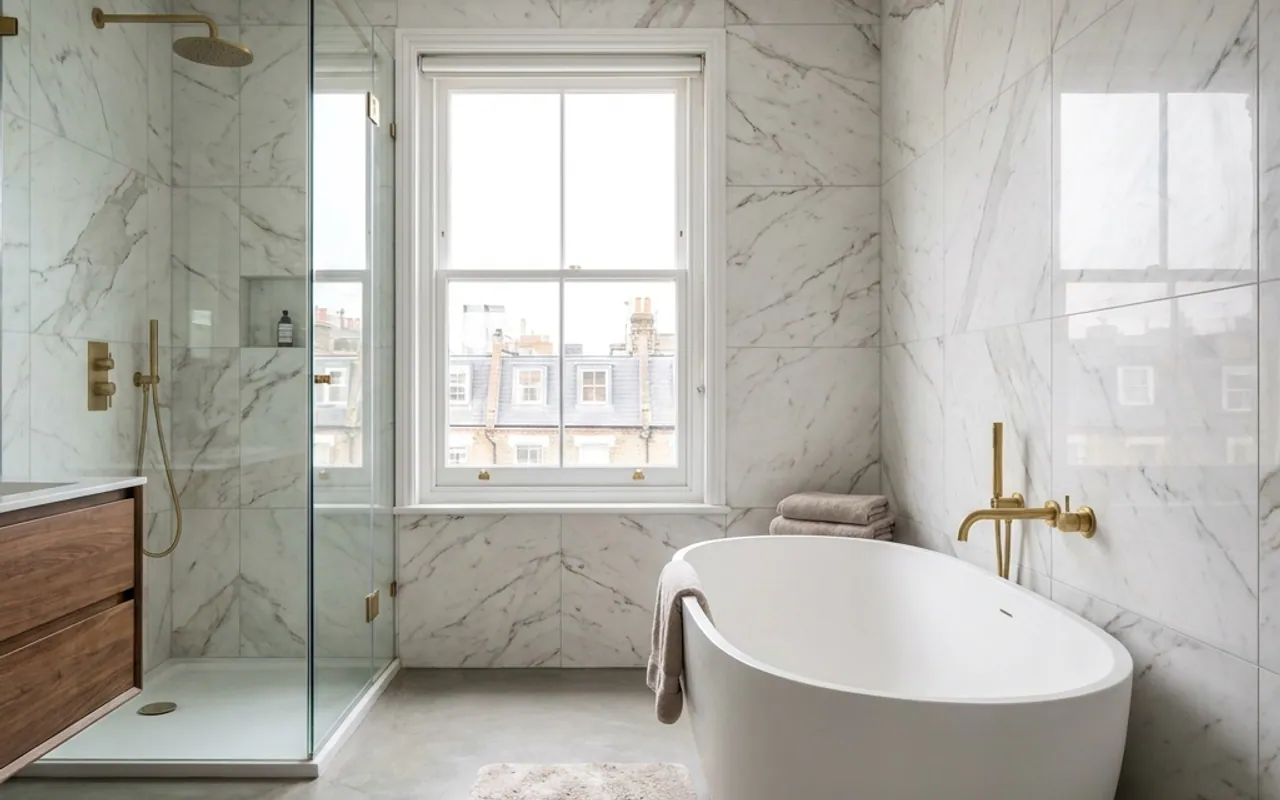
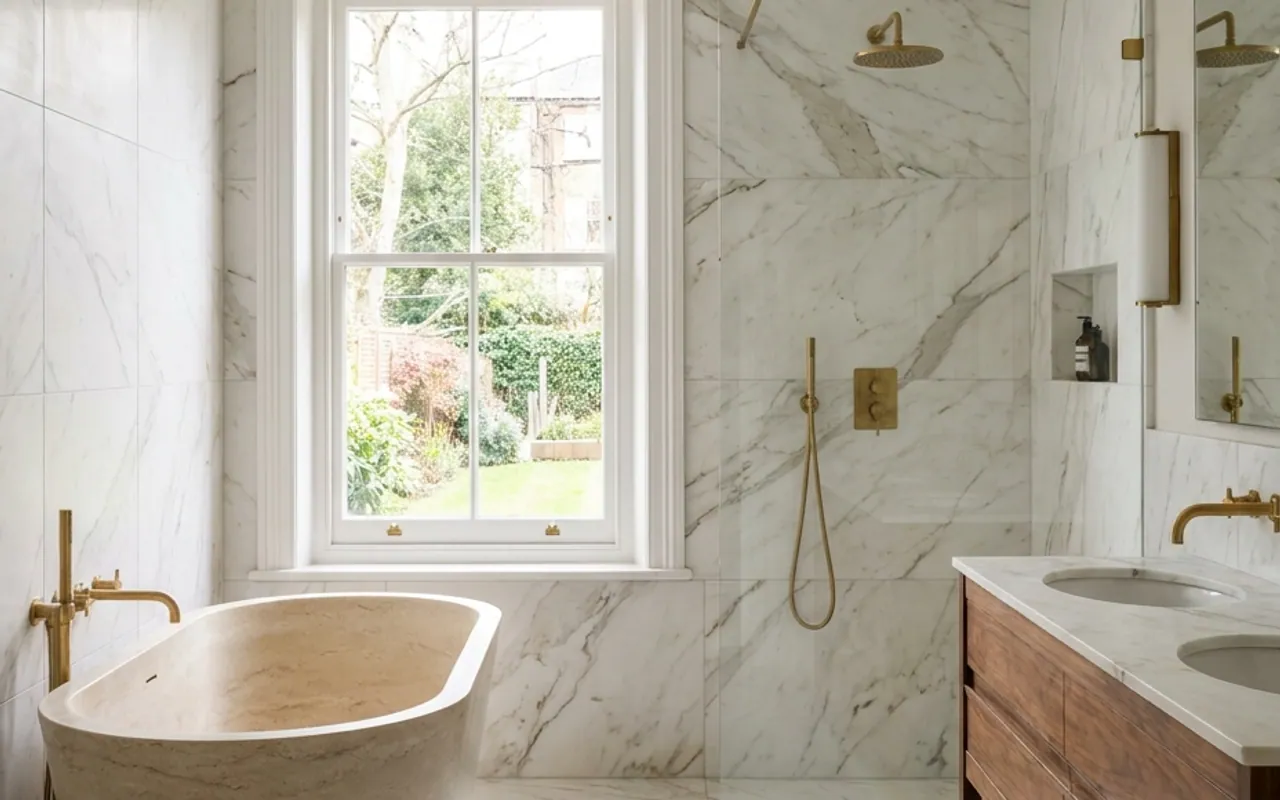
Brass and walnut: the warm-luxe London bathroom that won't date
Brushed brass taps, a bespoke walnut vanity, and marble — why this warm-luxe London bathroom combination outlasts every trend. Design guide for 2026.
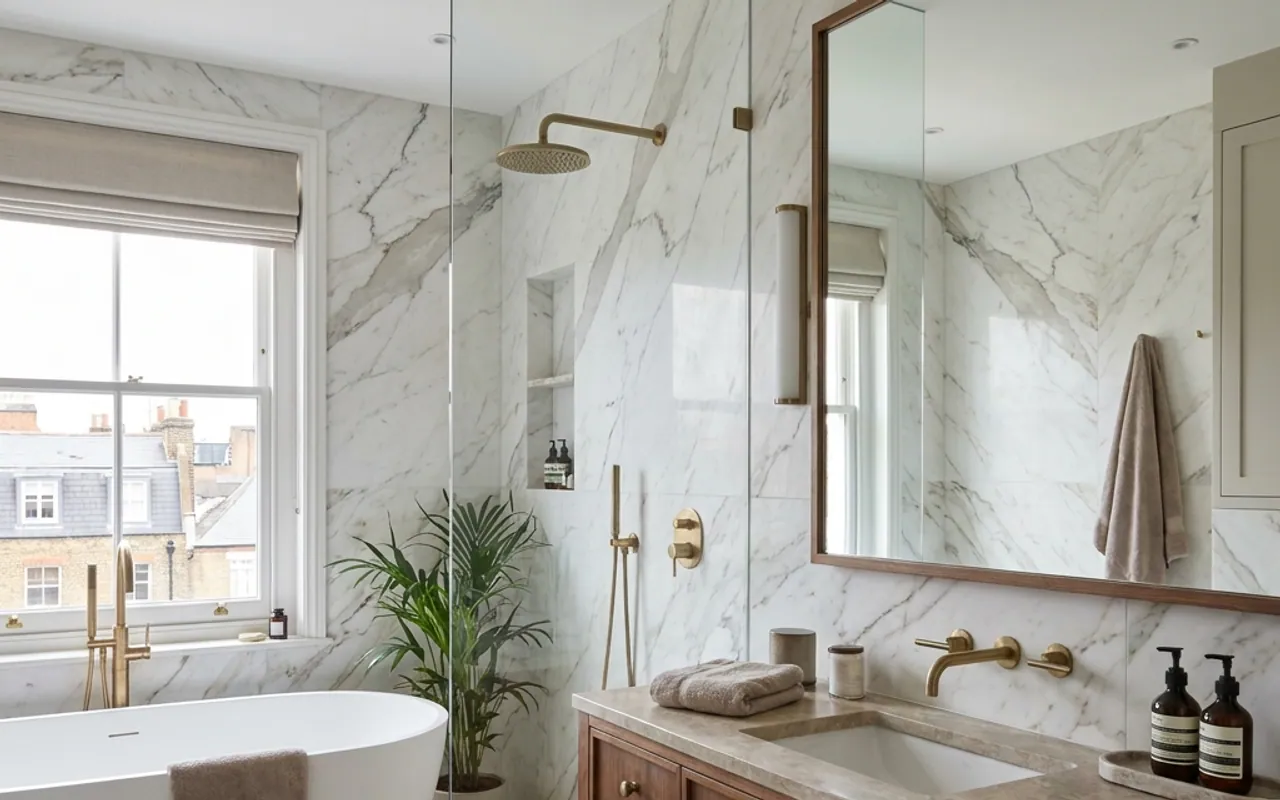
The all-grey, all-chrome bathroom had a good run. Visit any London house that was done up between 2014 and 2021 and you'll find it: grey large-format tile, chrome thermostatic bar valve, grey vanity unit from a bathroom showroom catalogue. It looked clean. It also looks dated now — and it will look more dated still in five years.
Warm metals and timber are different. Brass and walnut have been in bathrooms since before there was central heating. They'll be there long after the next trend. Here's how to do it properly in a London home in 2026.
Why warm materials read timeless
Cold materials — polished chrome, grey tile, white gloss — photograph well and look decisive in a showroom. The problem is that they rely entirely on trend consensus. Once the consensus shifts (and it always does), there's nothing underneath to carry them.
Brass and walnut carry material warmth. Unlacquered bronze hardware, oiled timber, natural stone — these things age into themselves. A slight patina on brass at three years, a deepening grain in oiled walnut, the gentle variation in a Carrara or Calacatta marble slab: none of that reads as neglect. It reads as quality.
The cold-chrome era peaked when Instagram rewarded flat, high-contrast images. As screens and tastes have moved on, the rooms that hold up are the ones with depth, texture, and warmth. The brass-walnut-marble trio delivers all three.
The brass finishes — and which to choose
Not all brass is the same. The finish choice changes both the look and the maintenance requirements significantly.
Polished brass is mirror-bright, very gold, and bold. It suits Georgian-replica and traditional styles, but it's unforgiving — every water mark shows, and it needs regular buffing to stay sharp. A committed choice.
Brushed or satin brass is the most popular finish right now, and for good reason. The surface is lightly textured, which diffuses light and softens the colour from gold toward warm champagne. Water marks are far less visible than on polished. It reads modern without trying too hard. This is the safe, versatile choice for most London bathroom projects in 2026.
Aged or antique "living" brass (also called unlacquered brass) is a lacquer-free finish that intentionally patinas over time — darkening and developing variation in colour. The result is beautiful and genuinely unique to your home. The honest caveat: it's not for everyone. It needs occasional cleaning to guide the patina rather than let it go blotchy, and it can look uneven in the early months before the patina settles. Don't specify it unless you understand and welcome the process.
PVD-coated brushed brass is the most durable option. PVD stands for physical vapour deposition — a vacuum process that bonds an extremely thin, hard metallic layer to the substrate at a molecular level. The result is a surface that won't tarnish, won't chip, and holds its colour for decades under daily use. For taps, shower valves, and anything that sees constant water contact, PVD is the specification we recommend. Brands like Crosswater MPRO Brushed Brass and Samuel Heath use PVD across their tap ranges for exactly this reason.
For a bathroom where the fittings will be used hard, PVD brushed brass is the answer. For a powder room or a lower-traffic ensuite, unlacquered aged brass can be a beautiful and considered choice.
Mixing metals — keep it disciplined
One of the most common mistakes in bathroom design is mixing metals without a plan. Brass and nickel, brushed and polished, warm and cool — all in the same room — creates visual noise that reads as indecision rather than eclecticism.
The brass-marble-walnut trio works because it's internally coherent. Everything pulls warm. If you want to break it slightly, a single brushed nickel element (a mirror frame, a towel hook) can work — but only if it's a considered accent, not a compromise.
Keep towel rails, cabinet handles, tap bodies, and shower valve in the same finish. It's a small discipline that makes a significant difference to the finished result.
The walnut vanity — doing it properly
Timber in a humid bathroom has a bad reputation — mostly because it's been done badly. Timber near water is fine if the detailing is right.
Solid timber vs veneer: for a vanity carcass in a humid room, solid timber isn't actually the best choice — it moves with moisture cycles and can crack or warp. A better specification is a moisture-resistant MDF or marine-grade plywood carcass, faced with a walnut veneer or solid walnut drawer fronts and door fronts. The result looks identical to solid timber, but the substrate is stable.
Sealing: walnut that's going into a bathroom needs to be either hard-wax oiled (penetrating, easy to maintain, slightly more tactile) or lacquer-sealed (harder film, more protective, slightly less natural feel). Either works; lacquer is the more durable choice for a vanity top and door faces. Whatever the finish, it must be applied to all six faces of every timber component — including the underside and the back, which most people forget.
Ventilation: this is the part that actually determines whether the vanity survives. Poor extraction — a fan that vents into the ceiling void rather than outside, or no fan at all — creates persistent humidity that will eventually defeat any finish. Extraction must be mechanical and ducted to outside. This matters for all London bathrooms, but it matters more when you have timber in the room.
Bespoke vs off-the-shelf: you won't find a walnut vanity unit at a mainstream bathroom showroom. What's on the market is mostly MDF with a "walnut-effect" foil wrap — it reads as cheap up close and degrades quickly. A genuine walnut vanity means bespoke joinery. TB&D builds these in-house through our carpentry workshop — same joiners, same timber, same site. It removes the coordination problem between a joiner and a bathroom fitter working from separate programmes.
A bespoke walnut vanity, wall-hung or freestanding, runs roughly £2,200–£4,800 depending on size, configuration, and internal fittings. That's the honest range for London in 2026.
Marble — book-matched and chosen carefully
Book-matched marble (two slabs mirrored so the veining creates a symmetrical pattern across a joint) is the right choice for a feature wall behind a freestanding bath or as a vanity splashback. It looks considered and deliberate, which it is — it requires careful template and cutting, and the supplier needs to be told at slab selection stage.
For a warm-luxe bathroom, choose marble with a warm undertone: Calacatta Gold, Arabescato, Bianco Ceppo, or similar. Cooler greys like plain Carrara work — but they tip the whole scheme cooler. If you want the warmth to read through the whole room, the marble should cooperate.
On practicality: honed marble (matte) is more forgiving than polished in a bathroom — it shows fewer water marks and is less slippery underfoot. It also suits the quieter register of this design better than a high-gloss slab.
Brands worth specifying
For brass fittings in London bathrooms, these are the ranges that come up consistently on design-led projects:
- Vola — Danish, minimal, exceptional engineering, PVD finish range available. Eye-watering prices, but they outlast everything.
- Perrin & Rowe — British heritage brand, ornate and traditional profiles, beautiful unlacquered brass options.
- Samuel Heath — Birmingham-made, PVD-coated, genuinely durable. The right balance of quality and value for most projects.
- Burlington — traditional British style, good mid-range price point for period-home schemes.
- Crosswater MPRO Brushed Brass — modern, clean geometry, PVD-coated, one of the better value options at the quality level.
- CP Hart — London showroom, stocks a wide range of the above, useful for seeing finishes side-by-side in a physical space.
- JTP / Brassware — a broader range, useful for coordinating accessories (toilet roll holders, hooks, towel rings) when you've already chosen your tap from a different brand.
On cost: expect brass taps to run 30–60% more than the chrome equivalent from the same brand. On a typical basin mixer, that means £180–£280 for a quality chrome unit versus £280–£480 for the same model in brushed brass PVD. For a full bathroom (basin, bath filler, thermostatic shower valve), budget an additional £600–£1,200 over chrome for brass throughout.
Lighting — one rule
Warm brass and oiled walnut look extraordinary under 2,700K warm white light. Under cool white (4,000K+), the brass reads greenish, the walnut goes flat, and the whole scheme loses what you paid for.
Specify warm white throughout: LED downlights, vanity mirror lights, any architectural lighting. This is a £0 decision at specification stage and a £800+ problem to fix after the room is complete.
Keeping it from dating
The irony of a "timeless" design is that it still requires a little restraint to stay that way. The brass-walnut-marble base is durable. What dates a room is the accessories and accent choices that get layered on top.
Save the trends for the cheap-to-change items — towels, bath mat, a robe hook, a small plant. A Matki or Vola shower valve lasts 25 years; the brushed cotton towels you hang on it can change with the decade. Keep the permanent elements (tiles, vanity, fittings) neutral, warm, and high-quality. Rotate the rest.
See how this principle plays out at scale in our completed London projects — the rooms that hold up after a few years are always the ones where the brief was tight.
Where this look fits in London
The warm-luxe bathroom suits Victorian and Edwardian period homes naturally — the proportions, the sash windows, the ceiling heights all cooperate. In London, that means it's at home in:
- Islington (N1) — Georgian and early Victorian terraces with generous bathroom footprints
- Kensington & Chelsea (SW3, SW7) — stucco-fronted period conversions, often with original window reveals that work beautifully with a freestanding bath underneath
- Hampstead (NW3) — detached and semi-detached Victorian and Arts & Crafts houses with larger bathrooms
- Fulham (SW6) — late-Victorian terraces, often being done up properly for the first time
It also works in well-proportioned modern flats, provided the joinery and stone specifications are strong enough to anchor it. The mistake in a modern apartment is to add brass fittings without anything else in the room to support the warmth — the marble and the walnut have to come with it.
For a detailed breakdown of what a full bathroom renovation costs at this specification level, see our 2026 cost guide.
Frequently asked questions
Will brass taps go out of style?
Brass in bathrooms has been around for centuries and pre-dates modern trends entirely. Brushed or aged brass sits in the same category as natural stone and timber — materials with enough inherent warmth and variation that they don't depend on trend consensus to look good. Chrome, by contrast, is a purely industrial finish that relies on minimalism being fashionable. The all-chrome bathroom is already looking dated in 2026.
Brushed vs polished vs aged brass — which should I choose?
Brushed (satin) brass is the most versatile and lowest-maintenance choice for most London bathrooms — it hides water marks and works in both modern and period contexts. Polished brass is traditional and bold but shows every mark. Aged or unlacquered brass patinas over time into something unique and beautiful, but needs a homeowner who understands and welcomes that process. If in doubt, brushed PVD-coated brass is the safe, durable answer.
Does brass tarnish in a bathroom?
Lacquered or PVD-coated brass (which covers most modern tap ranges from brands like Samuel Heath, Crosswater, and Vola) will not tarnish under normal bathroom use. The coating is the key — it prevents oxidation and keeps the colour stable for decades. Unlacquered living brass does tarnish and patina intentionally — that's the point of the finish, not a defect.
Is a walnut vanity ok in a humid bathroom?
Yes, if it's specified correctly. The key points are: use a moisture-resistant MDF or marine-grade ply carcass (not solid timber, which moves with humidity); seal all six faces of every timber component with hard-wax oil or lacquer; and ensure the bathroom has proper mechanical extraction ducted to outside. With those three things in place, a walnut vanity will perform and look good for decades.
How much more do brass fittings cost than chrome?
Expect brass to run 30–60% more than chrome for the same model from the same brand. On a quality basin mixer, that's roughly an additional £100–£200 per fitting. For a full bathroom — basin tap, bath filler, and thermostatic shower valve — budget an extra £600–£1,200 over chrome. PVD-coated brass at the quality end is the most durable option and worth the premium.
Lacquered or unlacquered brass?
For taps and shower valves — anything that sees daily water contact — PVD-coated or factory-lacquered brass is the practical choice. It won't tarnish and holds its colour without maintenance. Unlacquered living brass is beautiful on lower-traffic items like cabinet handles, towel hooks, or a freestanding bath tap in a guest bathroom where you're willing to maintain the patina. Be honest with yourself about the level of upkeep you'll commit to before specifying unlacquered on high-use fittings.
Thinking about a brass and walnut bathroom for your London home? Talk to us — TB&D Construction designs and builds the full package, including the bespoke walnut joinery, in-house.