Marble bathrooms in London — Calacatta, Carrara, Statuario (and when porcelain wins)
Marble bathroom costs, types, and honest maintenance realities for London homes — plus when marble-effect porcelain is the smarter call.
Marble looks like nothing else. That bright white ground, the slow sweep of grey and gold veining, the way it catches light from a sash window — it's the material that turns a bathroom into a room you actually want to be in. It's also porous, it etches from acids, and it needs more care than most homeowners expect. Here's everything you need to know before committing.
The marble types — and what they actually cost in London
Not all white marble is the same. There are three main options you'll encounter at London stone yards, and the price gap between them is significant.
Carrara is the workhorse of the white marble world — quarried in Tuscany, widely available, soft grey background with feathery blue-grey veining. It's the most affordable natural white marble and the most commonly fitted. In tile form (600×300mm or 600×600mm), London supply prices run £80–£180/m². As a slab, expect £150–£280/m² before fabrication.
Calacatta is quarried in the same Apuan Alps but in far smaller quantities. The ground is whiter — almost pure — and the veining is bolder: thick gold and grey sweeps rather than Carrara's fine lines. It reads as more dramatic. Supply price in London: £200–£450/m² as a slab, more for book-matched pairs. The price differential over Carrara is real and justified by scarcity.
Statuario is the rarest of the three. Bright white background, very fine grey veining — dramatic in the way that Calacatta is dramatic, but quieter and more refined. It's genuinely hard to source in London in quantity. Budget £400–£800/m² for slabs, and accept that lead times can stretch. If a supplier offers you Statuario at Carrara prices, it isn't Statuario.
Arabescato is worth a mention — a close relative of Calacatta with denser, more intricate veining and occasional gold tones. Good middle ground if Calacatta is too expensive but Carrara too plain.
Slab vs tile — and why book-matched marble is a different product entirely
Marble tiles work well in most bathrooms. Large-format tiles (600×600mm, 600×1200mm) show more of the veining and look more coherent than small mosaic cuts. They're easier to handle, easier to replace, and the material cost is lower than slab.
Slabs are a different proposition. A full-height slab feature wall — the entire alcove behind a freestanding bath, say, or the shower back wall and side walls cut from the same block — has a visual continuity that tile cannot replicate. You see the stone as a single continuous object, not a gridded collection of pieces.
Book-matched marble takes this further. Two adjacent slabs are opened like a book so the veining mirrors across the join — a butterfly effect that looks architectural rather than decorative. It's the technique you see in hotel lobbies and high-end Kensington bathrooms. It requires ordering matched slab pairs from the same block, fabricating precisely, and installing by someone who knows what they're doing. The cost premium over standard tiling is significant — typically £800–£1,500 extra in fabrication and setting-out time alone, on top of the slab material cost.
Honed vs polished — a practical choice, not just aesthetic
Polished marble has a mirror finish that makes the veining vivid and the room feel brighter. It also shows every watermark, fingerprint, and soap smear. More importantly, the polished surface is slippery underfoot when wet — a real risk on a bathroom floor. Etching (see below) also shows more obviously on a polished surface because the acid-damaged patch loses its reflective quality against the surrounding gloss.
Honed marble has a matte or satin finish. It's more forgiving on floors — better grip, less slippery, and etch marks are far less noticeable against the already-matte surface. Most experienced fitters recommend honed for bathroom floors as standard. Polished works well on walls where slip risk is irrelevant and you want the reflective quality.
Porosity, sealing, and the etching problem
This is where marble separates from every other bathroom material — and where buyers get surprised.
Marble is calcium carbonate. That means it reacts chemically with acids. The reaction produces a dull, rough patch — an etch mark — that is not a stain (it doesn't wash off) and is not damage in the sense of a scratch (it's a chemical alteration to the surface). Common culprits in bathrooms: limescale removers (highly acidic — never use them on marble), some toothpastes, perfume, citrus-based cleaners, and any spray cleaner not specifically rated for natural stone.
The fix for etching is re-polishing or re-honing — a professional job, not a DIY one.
On top of etching, marble is porous, which means it absorbs liquids if unsealed. An impregnating sealer (Lithofin MN Stain-Stop, StoneTech BulletProof, Faber Idroplus) penetrates the stone and blocks the pores without altering the surface appearance. Apply it before grouting and re-apply roughly once a year in a bathroom. The sealer doesn't prevent etching — nothing prevents etching except keeping acids away from the surface — but it does slow liquid absorption and makes cleaning easier.
Honest assessment: marble in a bathroom requires more attention than porcelain or quartz. In a family bathroom where children are using bathroom cleaner spray, or where limescale is a daily fight (hard London water makes this worse), that attention can become a burden. In a principal bathroom used mainly by adults who understand the material, it's a manageable and entirely worthwhile trade-off.
The porcelain marble-effect alternative
Large-format porcelain slabs have improved to the point where they're genuinely worth considering alongside real marble. Brands like Florim, Atlas Concorde, Laminam, Neolith, and Marazzi produce 1200×2400mm and even 3000×1000mm formats with digitally printed veining that, in the right light, is convincing. They're fired at high temperature, essentially non-porous, and hardness-rated for floors as well as walls.
The advantages are real: near-zero maintenance, won't etch, doesn't need sealing, consistent veining (no quarry variation), and cheaper to live with long-term. Supply prices run £80–£250/m² for quality large-format porcelain slabs — competitive with Carrara tile, significantly cheaper than Calacatta or Statuario.
The honest limitations: it's printed, not geological, so close inspection shows it in a way that real marble doesn't. It doesn't have the depth or translucency of stone. And it doesn't add the same premium to a property valuation in the way that real Calacatta or Statuario does at the top end.
Choose real marble when: you're in a high-end property where the material choice genuinely affects sale value (a principal bathroom in SW3, SW7, NW3, or NW8), you have a specific slab you fell in love with, you're doing a statement feature wall rather than an entire bathroom, or you want the tactile quality of natural stone.
Choose porcelain when: it's a shower floor (slip-rated porcelain beats marble on safety), a busy family bathroom with multiple users, you're in London hard-water territory and the etching risk is too high, or budget is the deciding factor.
Underfloor heating
Both real stone and large-format porcelain are excellent conductors — underfloor heating works particularly well under either material. If you're fitting a marble or stone bathroom floor, include UFH in the specification from the outset; it's far cheaper to run pipes before the tiles go down than to retrofit. A London bathroom renovation at the level where marble is the tile choice almost always includes UFH.
What a marble bathroom costs in London
The material cost is only part of the picture. Marble is a heavy, brittle material and requires experienced cutters and setters — fitters who work in it regularly, have the diamond blade equipment for complex cuts, and understand how to handle book-matched slabs without chipping a join. Labour cost for a marble bathroom is higher than a standard tiled bathroom, roughly 15–25% more on the fitting element.
A full bathroom renovation in London at the marble tier — real marble, slab feature wall, freestanding bath, aged-brass fittings, bespoke vanity — typically lands between £28,000 and £55,000+ depending on size and specification. Calacatta or Statuario book-matched slabs, a carved stone bath, and bespoke joinery will take you towards the top of that range and beyond.
If porcelain marble-effect is the direction, the same-quality bathroom in terms of layout and fittings typically runs £18,000–£32,000 — the material and fitting cost savings are real.
The period London context
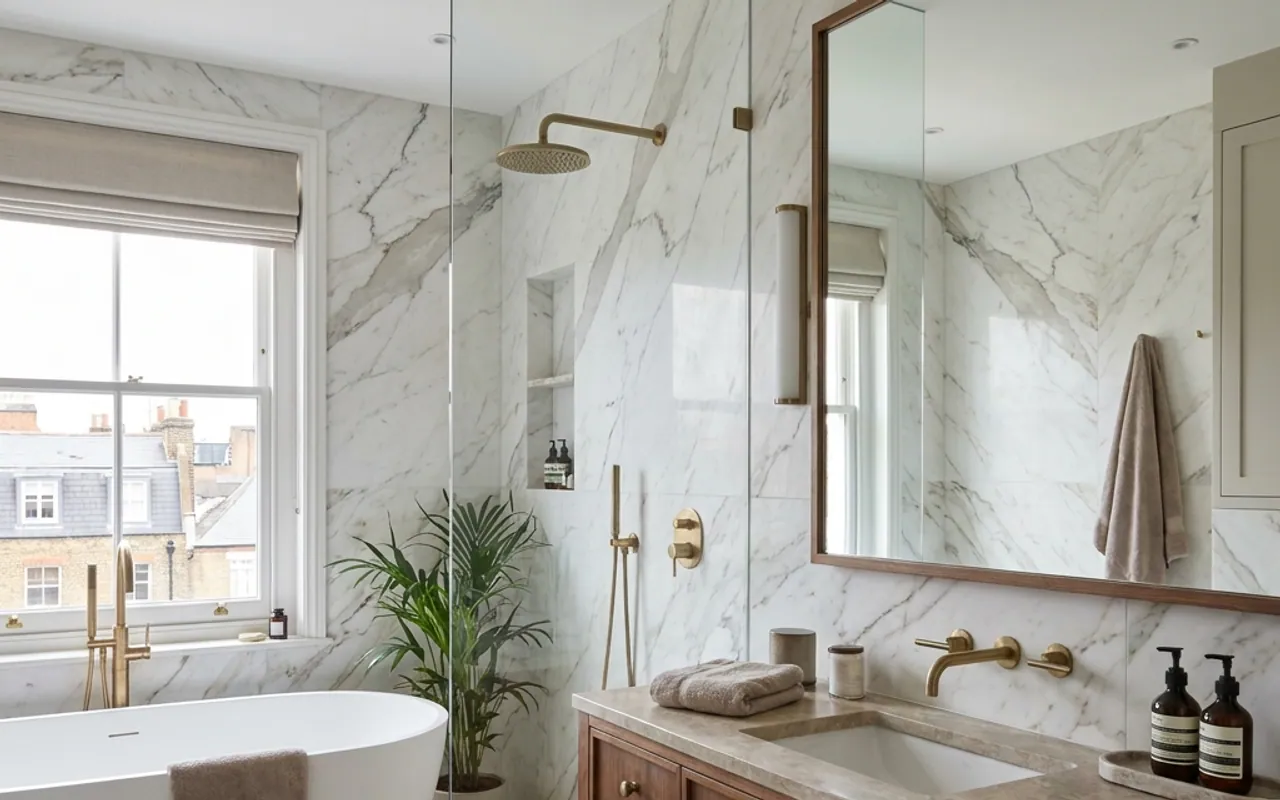
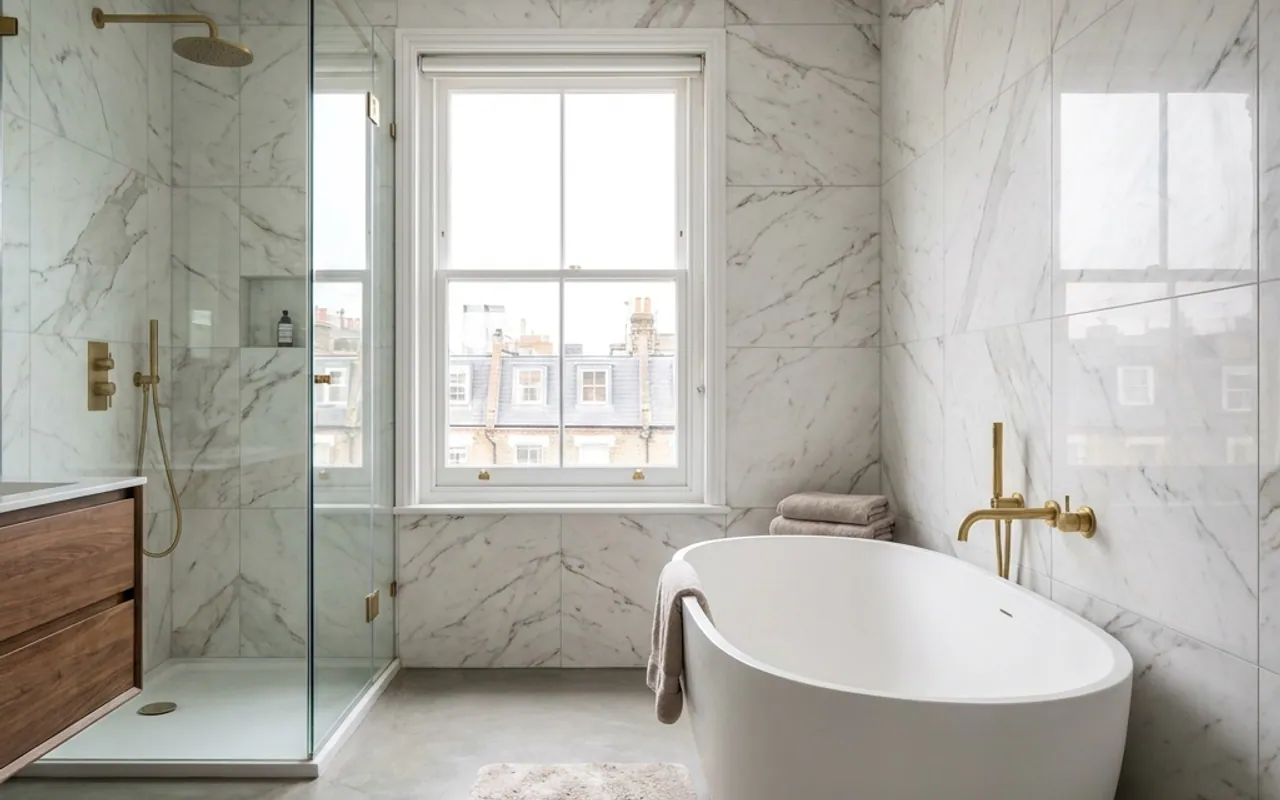
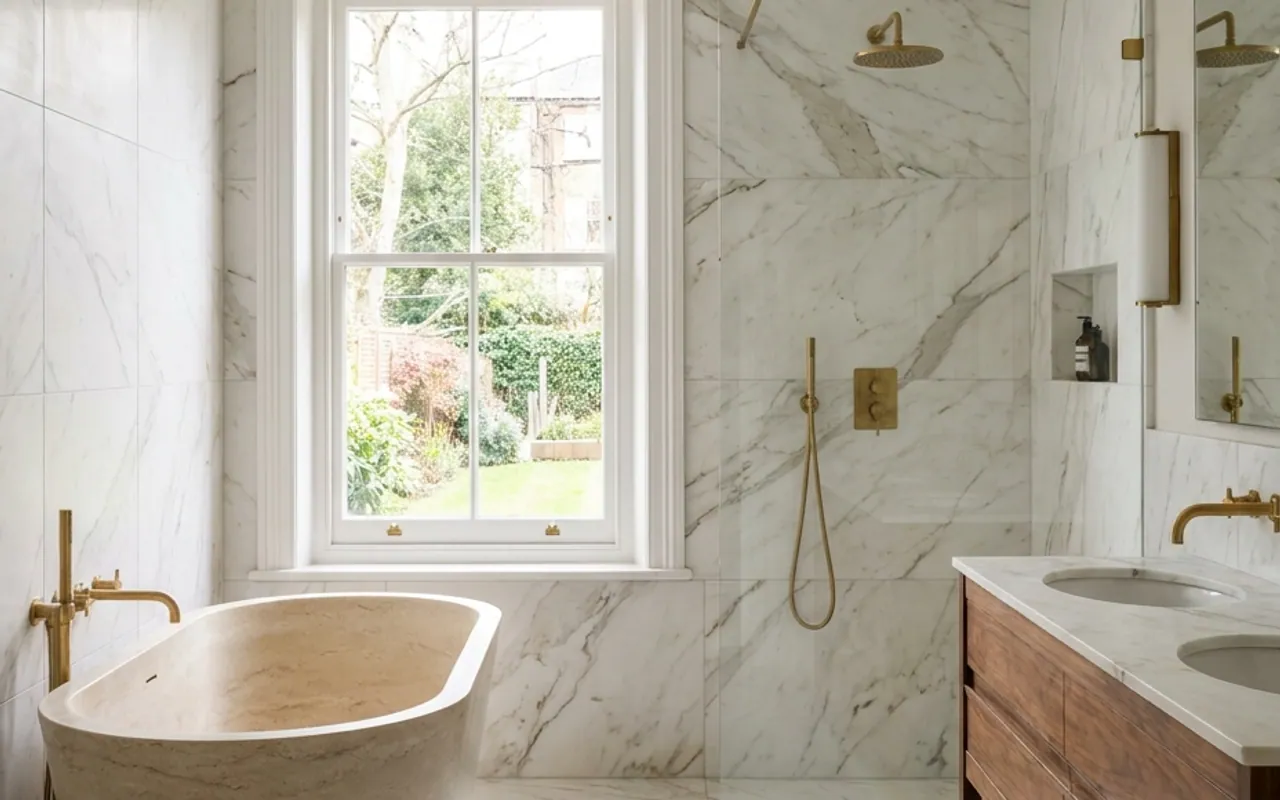
The bathrooms people are fitting marble into — Victorian and Edwardian houses in Kensington & Chelsea (SW3, SW7), Hampstead and Highgate (NW3), Westminster and St John's Wood (NW8) — already have the ceiling heights, original cornicing, sash windows, and heritage bones that marble suits perfectly. The style shown in our cover image — a freestanding carved stone bath beneath a full-height sash window, book-matched white marble walls with gold veining, a walk-in shower with an aged-brass rainfall head, a double walnut vanity with a marble top — is the bathroom that works in those houses. It doesn't look designed; it looks like it was always there.
TB&D Construction fits marble bathrooms across central London, working with specialist stone suppliers in Battersea, Clerkenwell, and Chelsea to source and match the right slabs. If you want to see examples, the project gallery has recent work.
Frequently asked questions
Is marble a good idea in a bathroom?
Yes — with caveats. Real marble is a genuinely beautiful material that suits London period properties and adds measurable value at the top end of the market. The trade-off is maintenance: marble is porous (needs annual sealing) and etches from acidic products including most limescale removers and some cleaning sprays. In a master bathroom used mainly by adults who understand the material, it's entirely manageable. In a busy family bathroom with hard London water, marble-effect porcelain is often the more practical choice.
How much does a marble bathroom cost in London?
A full marble bathroom renovation in London — real marble, slab feature wall, freestanding bath, quality brass fittings, bespoke vanity — typically costs between £28,000 and £55,000 or more, depending on size, marble type, and specification. Carrara is the most affordable option; Statuario at the top end of the range. An equivalent bathroom using large-format marble-effect porcelain typically runs £18,000–£32,000.
What is the difference between Calacatta and Carrara marble?
Both are Italian white marbles from the Apuan Alps in Tuscany, but they are distinct materials with different characteristics and prices. Carrara has a softer grey-white background with fine, feathery blue-grey veining — it is widely available and the most affordable option, typically £80–£180 per square metre in tile form. Calacatta has a whiter, brighter background with bolder, more dramatic gold and grey veining; it is rarer, more expensive (£200–£450 per square metre as a slab), and considered the premium choice. Statuario is rarer still: bright white with fine grey veining, typically £400–£800 per square metre.
Does marble stain or etch in a bathroom?
Marble can do both but the mechanisms are different. Staining happens when a liquid is absorbed into unsealed stone — prevented by applying and regularly renewing an impregnating sealer. Etching is a chemical reaction: marble is calcium carbonate and reacts with acids, creating a dull patch on the surface. Common causes in bathrooms include limescale removers, perfume, citrus-based cleaners, and some toothpastes. A sealer does not prevent etching. Etched marble requires professional re-polishing or re-honing to correct.
Real marble or marble-effect porcelain — which should I choose?
Choose real marble when the material choice affects resale value (a principal bathroom in a high-end London property), you have a specific slab you want, or you want the depth and tactile quality of natural stone. Choose large-format porcelain (Florim, Atlas Concorde, Laminam, Neolith) when it is a shower floor, a busy family bathroom, you are concerned about London hard-water and etching, or budget is the deciding factor. Porcelain is near-zero maintenance, doesn't etch, and is slip-rated for floors.
How often does marble need sealing in a bathroom?
Apply an impregnating sealer before the marble is grouted and re-apply approximately once a year in a bathroom environment. The sealer penetrates the stone and blocks the pores, slowing liquid absorption and making the surface easier to clean. It does not prevent etching from acids. A simple water-bead test tells you when resealing is needed: drop water on the surface and if it soaks in rather than beading, it is time to reseal.
Thinking about a marble bathroom in London? Get in touch — we'll look at your space, help you choose the right stone or porcelain, and quote a proper fixed price.