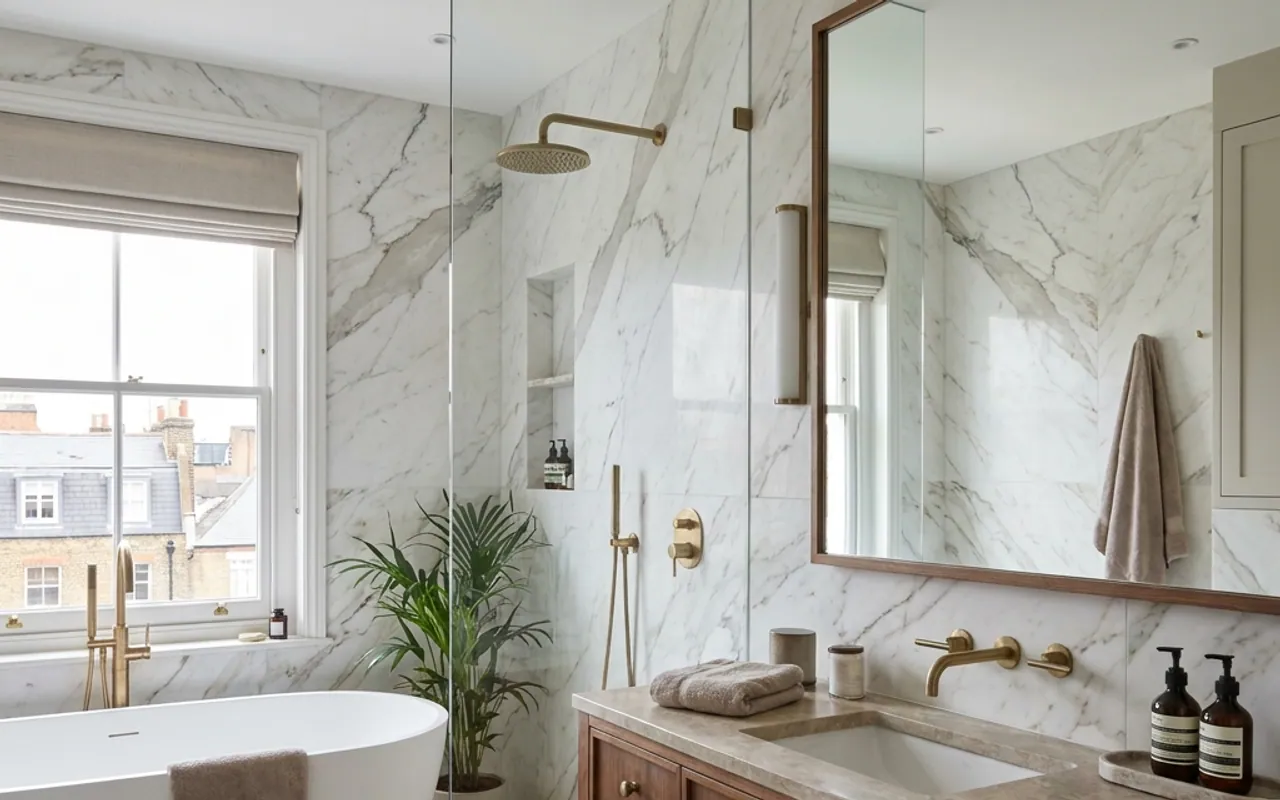
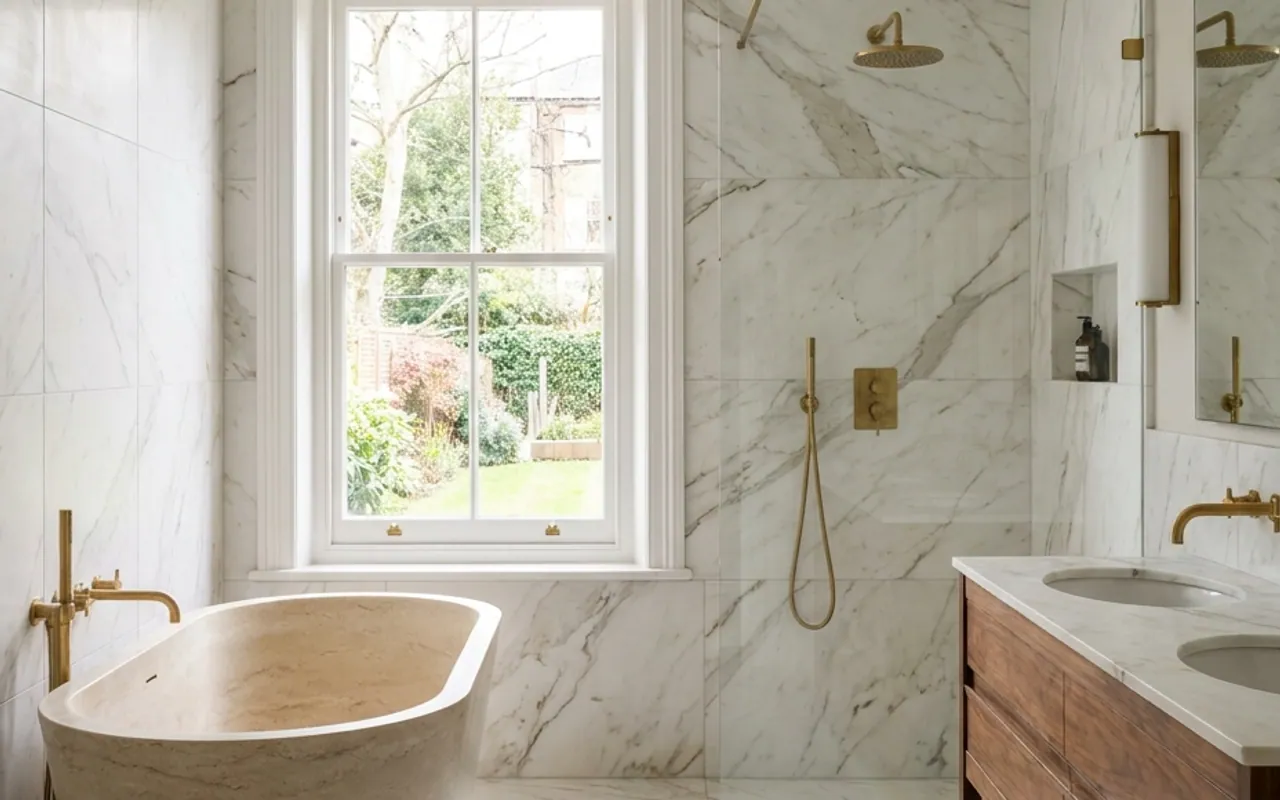
Freestanding baths in a London bathroom — stone, stone-resin, acrylic or cast iron?
Freestanding bath materials compared for a London bathroom — weight, warmth, price, and the floor-loading reality period joists can't afford to ignore.
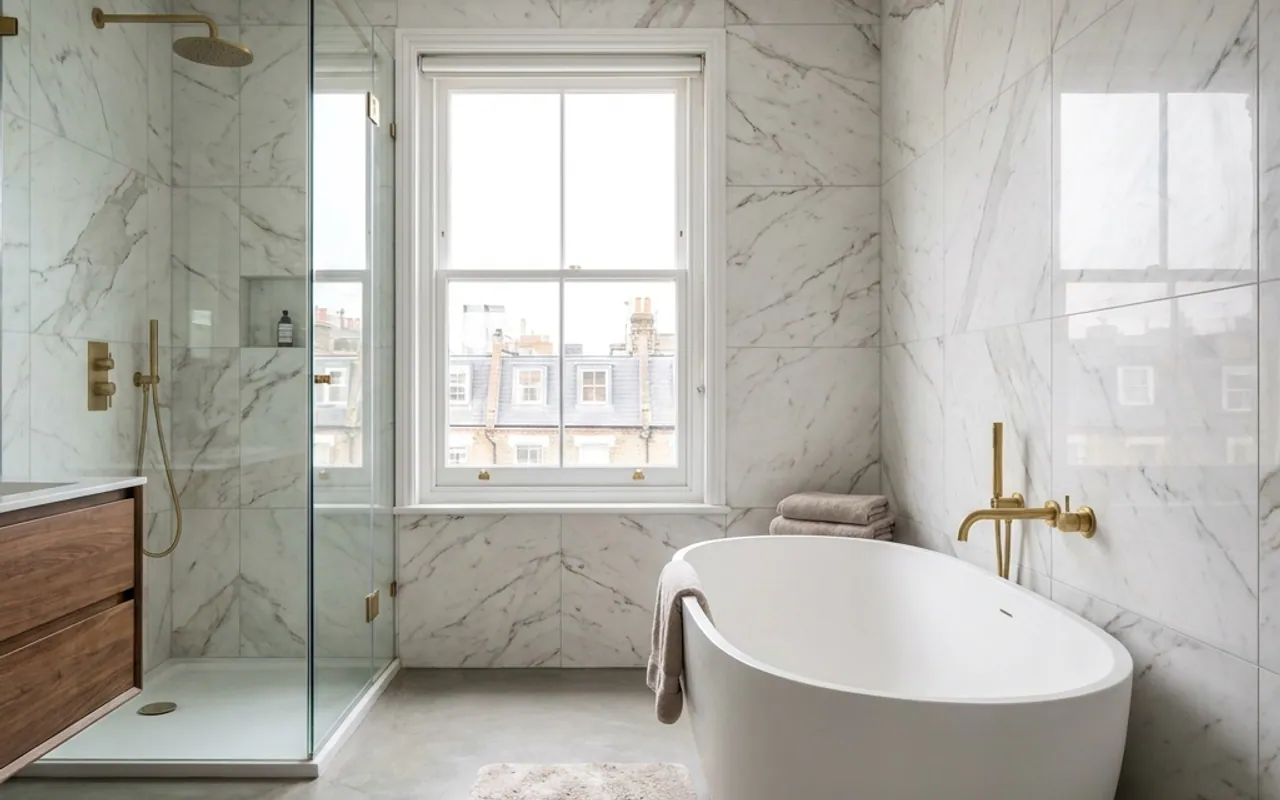
A freestanding bath is the one choice in a bathroom that still stops people. Set beneath a sash window with London rooftops beyond, flanked by book-matched marble and a frameless shower, it reads as a decision — not just a fitting. But the material you choose determines everything: warmth, weight, price, and whether your Victorian floor joists are even in a position to say yes.
The materials — what each one actually is
Acrylic
The practical default. Most freestanding baths sold in the UK are acrylic — a vacuum-formed sheet over a fibreglass-reinforced base. Empty weight: 25–40 kg. That's light enough for any floor, easy to manoeuvre up a terraced staircase in Battersea or Fulham, and simple to fit. The tub is warm to the touch, which is pleasant when you first get in. It holds heat reasonably well.
The honest downsides: acrylic flexes slightly, especially cheap single-skin versions (tap the underside — a hollow drum sound means thin walls). It scratches. And the satin/gloss finish has a different quality to stone. Cost for a decent acrylic freestanding: £600–£2,500 for the bath itself. Fine for a family bathroom in SW18 or a second bathroom in a Fulham conversion.
Steel enamel
The mid-market alternative. A pressed steel shell with a vitreous enamel coating — more rigid than acrylic, harder to scratch, and noticeably colder to the touch until the water warms it. Empty weight: 35–55 kg. More durable long-term; the enamel surface chips rather than scratches, and is harder to repair if it does. Cost: £1,000–£3,500. Worth considering if durability matters and budget is tight, but it doesn't have the thermal quality of stone resin.
Cast iron
Traditional roll-top baths — the kind Drummonds have made beautifully for decades — are cast iron. The heat retention is genuine: cast iron holds hot water temperature far longer than any other material. It's a real, physical pleasure. Empty weight: 100–180 kg, sometimes more. That's before water (~250–300 kg) and a bather. For a ground-floor Victorian terrace with solid floors, fine. For a first-floor bathroom in an Edwardian townhouse in Hampstead NW3 or Richmond TW9, the joists must be checked. Cost: £2,500–£8,000+, and Drummonds' restoration pieces considerably more.
Stone resin, solid surface, and composite
This is the category in the cover photo — and the one that currently dominates high-spec London bathroom renovations. Brands like Lusso Stone, BC Designs, Apaiser, and Waters Baths all make freestanding baths from mineral-loaded resin composites: Cristalplant, Corian-type materials, or proprietary "stone composite" blends. The look is matte and monolithic. The feel is warm — closer to acrylic than to cast iron — because the resin content insulates. Scratches are sandable and repairable, unlike acrylic.
Empty weight: 80–130 kg, depending on the brand and wall thickness. Wall-filling quality, heavy enough to feel substantial, light enough not to automatically require structural work. Cost for the bath: £2,000–£8,000, with brands like Apaiser at the top end. This is the category worth spending on for a principal bathroom in a Battersea SW11 townhouse or a Richmond TW10 renovation.
Victoria + Albert — volcanic limestone and resin
Victoria + Albert's "Englishcast" material is worth naming separately: volcanic limestone and resin, fired in a specific process that gives a surface quality unlike anything else in its price range. Empty weight varies by model — most land at 70–90 kg. Warm to touch, excellent heat retention for a composite. Cost: £3,000–£7,500. A serious option for anyone who wants stone-resin quality with a known brand behind the warranty.
Natural carved stone
Travertine, limestone, marble — a bath carved from a solid block is a true statement piece. Empty weight: 250–500 kg or more, depending on the stone and thickness. Heat retention is genuinely exceptional. Cost: £8,000–£30,000+ for the bath alone, and that's before installation. Reserved for ground-floor situations with concrete subfloors, or upper floors that have been specifically engineered. Exceptionally rare in London except in top-end projects in NW3, SW7, or TW10.
The headline technical issue — floor loading
This is the thing most London homeowners don't find out until the bath is on order.
UK domestic floor design loads are set at 1.5 kN/m² (~150 kg/m²) under BS EN 1991-1-1 (the UK National Annex for Eurocode 1). That figure is a distributed load — spread evenly across the whole floor area. A freestanding bath is a concentrated load sitting on four feet or a small base footprint. A stone-resin bath at 100 kg empty, plus ~250 kg of water (a full 400-litre bath), plus a 90 kg bather: you're looking at 440 kg on a footprint of roughly 0.15 m². That's a very different structural ask from a person standing on the floor.
Why this matters in London specifically: the majority of first-floor and second-floor bathrooms in Victorian and Edwardian London terraces — SW11 Battersea, SW6 Fulham, SW18 Wandsworth, NW3 Hampstead — are timber-joisted. Those joists were designed for domestic loads, not for industrial-scale point loads. A cast-iron bath or a natural-stone bath on original 100-year-old timbers without investigation is a gamble.
What TB&D Construction does before ordering a heavy bath: we look at the joist span, the joist depth and centres, and where the bath sits relative to the structure. On anything above 80–90 kg empty, we'll call in a structural engineer for a desktop check (usually £200–£400 for a simple opinion). Common fixes include joist doubling (sistering a second joist alongside the existing one), adding a load-spreading plate, or repositioning the bath to bear onto a load-bearing wall rather than mid-span. It's a manageable issue — but it needs to be dealt with at the design stage, not after the bath is delivered to the hallway.
Getting a heavy bath into a London townhouse
A 130 kg stone-resin bath up four flights of a Victorian staircase in Hampstead is not a two-man job with a sack truck. Some baths come in sections (BC Designs' freestanding models can be split). Others need to be craned — we've taken baths up through sash windows on period properties in SW11 and TW9. This needs planning early: access, scaffolding or a slinging point, and coordinating with neighbours if it overhangs the street. Factor this into the programme, not as an afterthought.
Taps — floor-standing or wall-mounted?
For a true freestanding bath positioned away from walls, a floor-standing bath filler is the natural choice — a tall column rising from the floor, with the spout over the bath rim and the controls in reach. It reads beautifully in brass or brushed nickel. Brands worth specifying: Crosswater, Vola, Lefroy Brooks, Waterworks. Budget £600–£2,500 for the filler alone at the quality level a stone-resin bath deserves.
Wall-mounted fillers work where the bath sits close to — or directly against — a wall, as in the cover photo. A wall-mounted brushed-brass bath filler with a floor-mounted polished concrete setting gives a cleaner floor plane. The plumbing termination needs to land precisely on the wall, so this requires fixing the bath position before first-fix plumbing — it's not something you decide after the tiles go on.
Both options need a separate waste and overflow. Many freestanding baths use a flexible push-fit waste that runs under the floor — this needs a floor void to be planned for, especially on a concrete screed. Check before the screed goes down.
Placement — under the window
The classic: bath beneath a sash window, light falling in from above. For a London townhouse it works brilliantly. The practical notes:
- Leave 200mm minimum from the bath rim to any wall or window sill — you need to reach the taps and clean behind.
- Ensure the wall-mounted filler (if specified) lands on a surface that will hold a fixing into structure, not just plasterboard.
- Think about the view from outside — a ground-floor bathroom on a street needs privacy film or internal shutters.
- A bath under an opening sash in a NW3 or TW10 property adds natural ventilation, which helps extraction.
When acrylic is the right call
Not every bathroom needs a stone-resin bath. For a second bathroom, a family bathroom used daily by kids, or a bathroom in a flat above others where floor loading is genuinely constrained — a good acrylic freestanding from Waters Baths or BC Designs at £900–£2,000 is a sensible, honest choice. It will look excellent with good tiles and quality fittings. The money saved can go on the shower, the tiles, or the fittings — often a better allocation. As part of a full London bathroom renovation, the bath is just one line in the budget.
What it all costs — a summary
| Material | Empty weight | Bath cost (approx.) | Floor check needed? | |---|---|---|---| | Acrylic | 25–40 kg | £600–£2,500 | No | | Steel enamel | 35–55 kg | £1,000–£3,500 | No | | Cast iron | 100–180 kg | £2,500–£8,000+ | Almost always | | Stone resin / composite | 80–130 kg | £2,000–£8,000 | Likely | | Victoria + Albert Englishcast | 70–90 kg | £3,000–£7,500 | Sometimes | | Natural carved stone | 250–500 kg+ | £8,000–£30,000+ | Always |
For the full picture of where the bath fits in the overall spend, see our bathroom renovation cost guide for London in 2026 or browse completed projects in our project gallery.
Frequently asked questions
How much does a freestanding bath cost in London?
The bath itself ranges from £600–£2,500 for a good acrylic, £2,000–£8,000 for a stone-resin or composite model, and £8,000–£30,000+ for natural carved stone. Installation on top of the bath cost is typically £600–£1,200 depending on access, floor prep, and tap type — plus any structural work if joists need reinforcing.
Will my floor take a stone bath?
It depends on your floor structure and the bath's position relative to the joists. UK domestic floors are designed for 1.5 kN/m² (approximately 150 kg/m²), but a heavy freestanding bath filled with water creates a concentrated point load that can exceed this. First-floor timber-joisted bathrooms in Victorian and Edwardian London properties — common in Battersea, Wandsworth, Fulham, and Hampstead — often need a structural engineer's check before committing to a cast-iron or natural-stone bath. Joist doubling or load-spreading is the typical fix and costs £300–£800. Don't skip this step.
Stone-resin vs acrylic — which is better?
Stone-resin wins on aesthetics, warmth to touch, repairability, and rigidity. Acrylic wins on weight (25–40 kg versus 80–130 kg), cost, and ease of installation. For a principal bathroom you plan to keep for 15+ years, stone-resin is worth the premium. For a second bathroom or a budget-conscious refit, a quality acrylic freestanding delivers 90% of the look at a fraction of the cost.
Do freestanding baths stay warm?
Cast iron has the best heat retention by a significant margin — the thermal mass holds hot water temperature for a long time. Stone-resin and volcanic limestone composites (such as Victoria + Albert's Englishcast) are also good. Acrylic and steel enamel lose heat faster. If long soaks matter, choose cast iron or a quality stone-resin composite and insulate the room properly.
Can you fit a freestanding bath in a small London bathroom?
Yes, but you need to be disciplined about sizing. Many stone-resin freestanding baths come in at 1,500 mm or 1,600 mm long — shorter than a standard 1,700 mm built-in. A 1,500 mm freestanding in a 4–5 m² bathroom can work well. The key is leaving enough circulation space around all sides (300–400 mm minimum) and not forcing a freestanding bath into a space that really needs a built-in panel bath. A wet zone or walk-in shower alongside can feel more generous than a cramped freestanding layout.
Wall-mounted or floor-standing bath taps?
For a bath positioned away from all walls, a floor-standing filler is the natural choice — tall column, spout over the rim, controls at hand height. For a bath set against a wall, a wall-mounted filler can look cleaner and leaves the floor plan unobstructed. Wall-mounted positions must be fixed before first-fix plumbing; floor-standing fillers are more flexible but need a floor void for the pipework. Both work well — it depends on the bath position and the room layout.
Thinking about a freestanding bath for your London bathroom? Get in touch — we'll look at your floor structure, talk you through the materials, and spec the whole room properly before anything gets ordered.